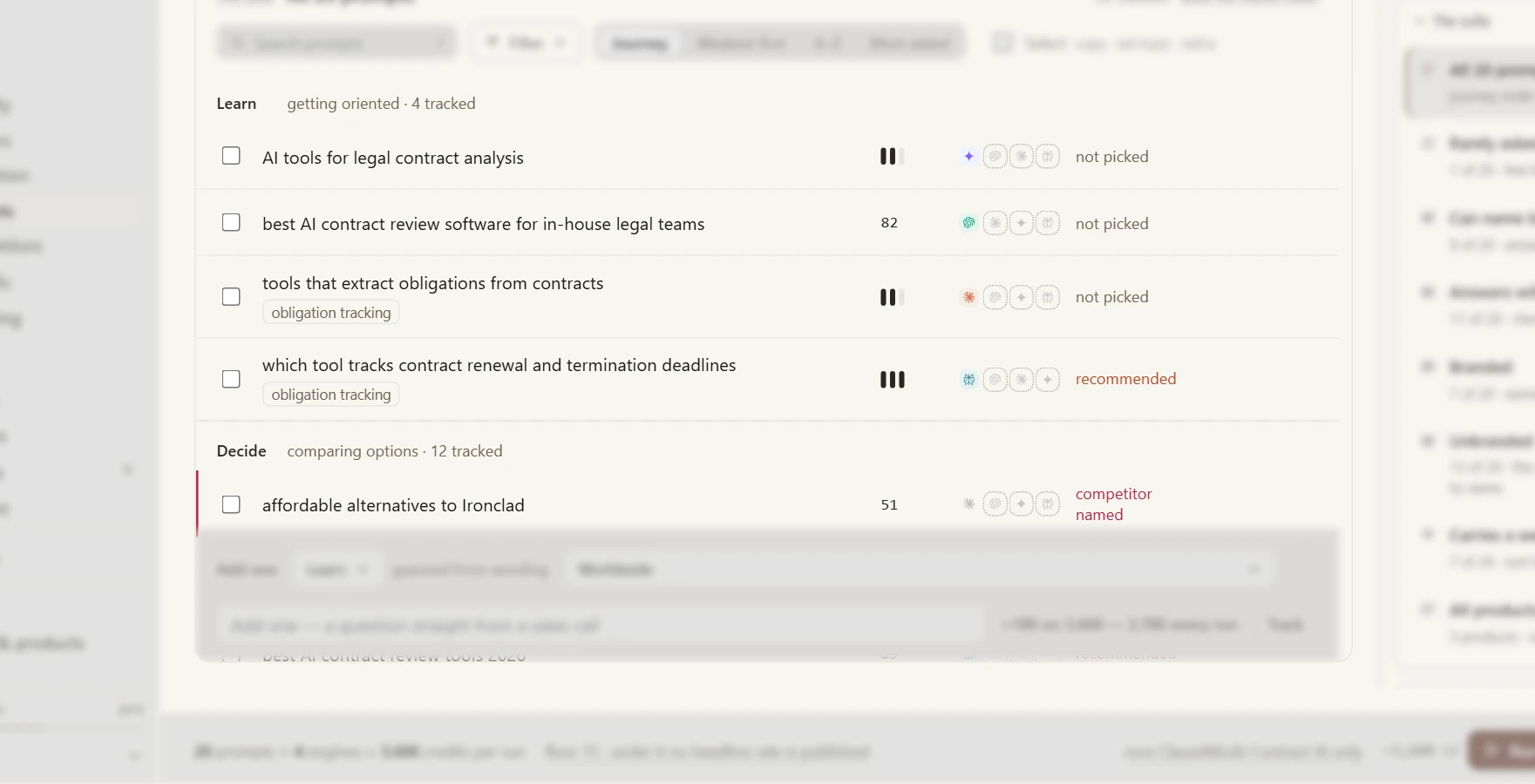
Prompts is the list of questions your buyers ask AI, with what came back on every engine you track: recommended, passed over, or handed to a competitor. You’ll know which questions you’re losing, and which ones the engines search for that nobody tracks yet.

Each question you track ends in one of five outcomes, and each outcome has a different fix. The example workspace tracks 20 questions on 4 engines: recommended on 4, named but not picked on 12, and handed to a competitor on 4. Those four are where to start.
| Outcome | What happened | What fixes it |
|---|---|---|
| Recommended | Named, and put forward as the pick | Keep it, and watch that it holds |
| Named, not picked | In the list, never the choice | Positioning: the sentence that says who you are for |
| Competitor named | A competitor was put forward and you were not | The comparison the answer already draws, answered on your page |
| Not named | Not in the answer on any engine | A page or a source to win, filed by reason on Answers |
| No answer stored | The engine returned nothing usable this time | Nothing; it is reported, never counted as not named |
Early questions, comparisons and final picks need different work. Losing a learning question to a competitor’s blog means a page you don’t have; being named but not picked in a comparison means a sentence you don’t say. Questions that name your brand are kept apart: they show whether an engine knows you at all, and who it offers instead.
Your first questions are proposed from your site and your category, each with the reason it was picked. After that, the answers suggest more.
Each question is asked on every engine you track, three times by default, and each row says which engines named you and which didn’t.
Remove a question and every answer it produced stays on record. Charts break where your list changed, instead of comparing unlike with unlike.
Before an assistant answers, it often searches the web. Prompts shows the searches it actually ran for your questions, and how often: every time, or in 3 of 4 measurements. A search that comes up every time and that nobody tracks is the cheapest question to add, at one credit.
Where search demand is shown beside a question, it is a range such as 100–1k a month, with its source and date, labelled est. It is search volume: nobody publishes how often a question is asked of an assistant, and Praised doesn’t pretend to.
Prompts is the questions you track and what came back. It is not a keyword tool, and these are the claims it refuses.
| It does not | What it does instead |
|---|---|
| Report how often a question is asked of an assistant | Shows search volume as a range with source and date where one exists, labelled est. |
| Invent questions | Proposes them from your site, your category and later from the answers, each with the reason |
| Turn five outcomes into one score | Counts each outcome apart, because each has a different fix |
| Compare across a change to your list | Breaks the chart where your questions changed and makes no claim across the break |
Measure your brand once, and Prompts shows every question, what each engine answered, and what the engines searched for.