Sources is the list of pages AI assistants read before they answer about you, with the one step that can win each of them: every site they cite, how often, what it says about you, and whether you are on it.

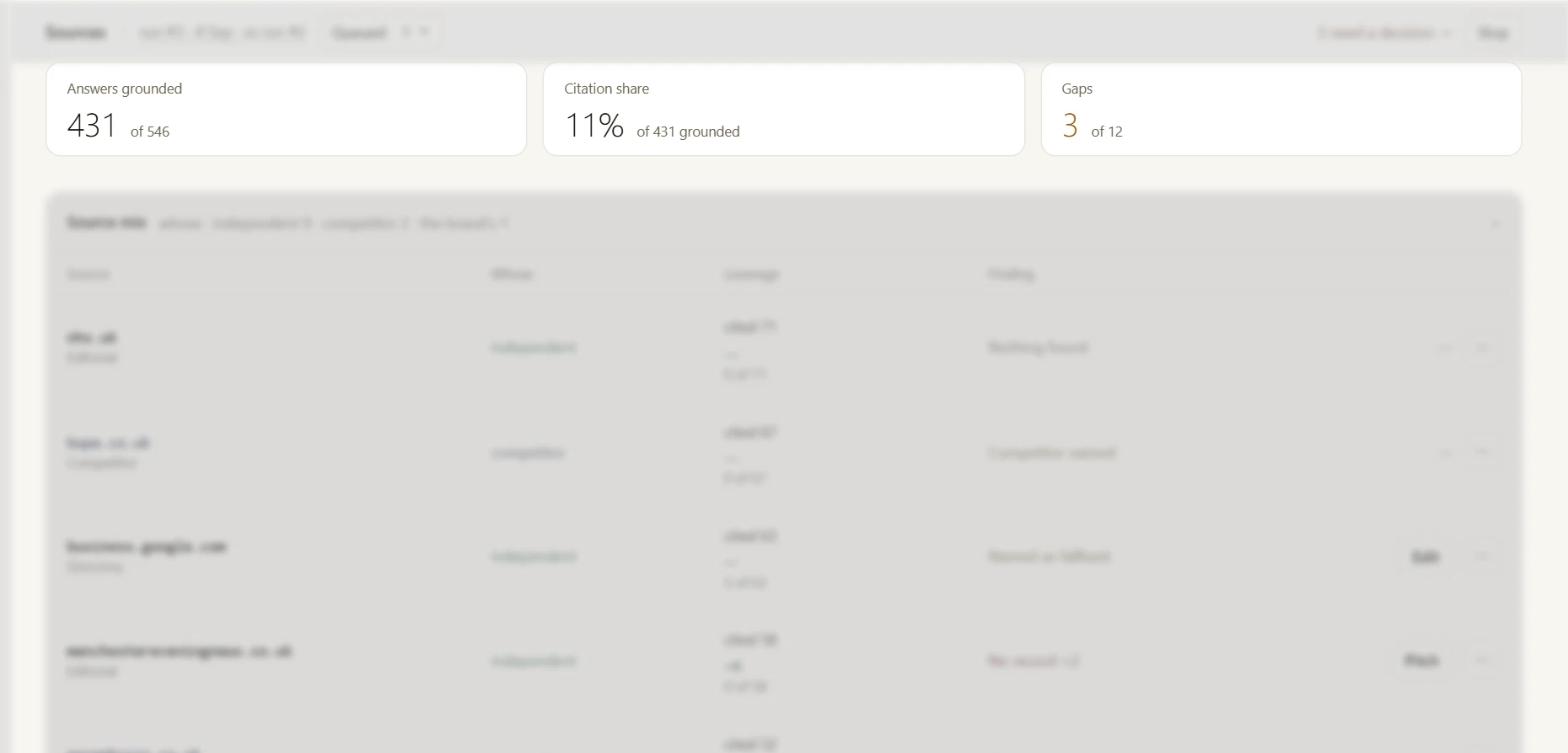
Assistants build their answers from a handful of sites. Sources shows you which ones, and how much of the answer each carries. In the example workspace, 431 of 546 answers cited at least one source; 11% of those cited a page the brand owns; and 3 of 12 trusted independent sites never name the brand at all. Those three are the gaps worth closing first.
Every site gets one plain reading of where you stand on it and one next step. You don’t have to work out whether a page matters, or what to do about it.
| Where you stand | What it means for you | Worth knowing |
|---|---|---|
| Only one named | The page names you and no competitor | Cited 12 times and naming only you: worth more than it looks |
| Named among others | You share the page with competitors | Which competitor the answers picked from it |
| Named rarely | You appear in a few of the answers that cite it | Often the closing line, never the pick |
| Never named | Cited for your questions, and you are not on it | The pitch that puts you on it |
| Couldn’t check | The page could not be read this time | Shown with its read date, never as never named |
Each site earns the step that can change it, drafted from your approved facts and the evidence. Nothing sends itself.
For a listing you can claim: the correction, with your approved facts attached. A wrong price on a review site goes through its vendor portal, and the draft names the portal.
For a page that should name you: a pitch to whoever runs it, with how often it is cited, which questions it wins and which competitors it names.
For a thread the engines cite: a reply as the brand, disclosed. A visible, identified reply becomes part of what they read next time.
Classifying an unknown site costs one credit. Every other step costs nothing until a person sends what it drafted.
Every row shows how it changed since the last measurement, and whether the change is real or within noise. Roughly half the sites cited in a category turn over month to month; a site the engines stop citing drops off your list instead of lingering.
Sources is the record of what the engines read. It is not a ranking of the web, and these are the claims it won’t make.
| It does not | What it does instead |
|---|---|
| Score a site’s influence | Counts how many of your answers cited it, and for which questions; a site outside what was measured is marked as such |
| Send a correction, a pitch or a reply | Drafts each one from your facts and the evidence; a person sends it and marks it sent |
| Edit a Wikipedia article | Opens the Talk page request with the conflict-of-interest template; editing the article about your own company gets reverted |
| Read a site as never naming you when it could not be read | Reports couldn’t check, with the read date |
Measure your brand once, and Sources lists every site the answers cite, what each says about you, and what to do next.