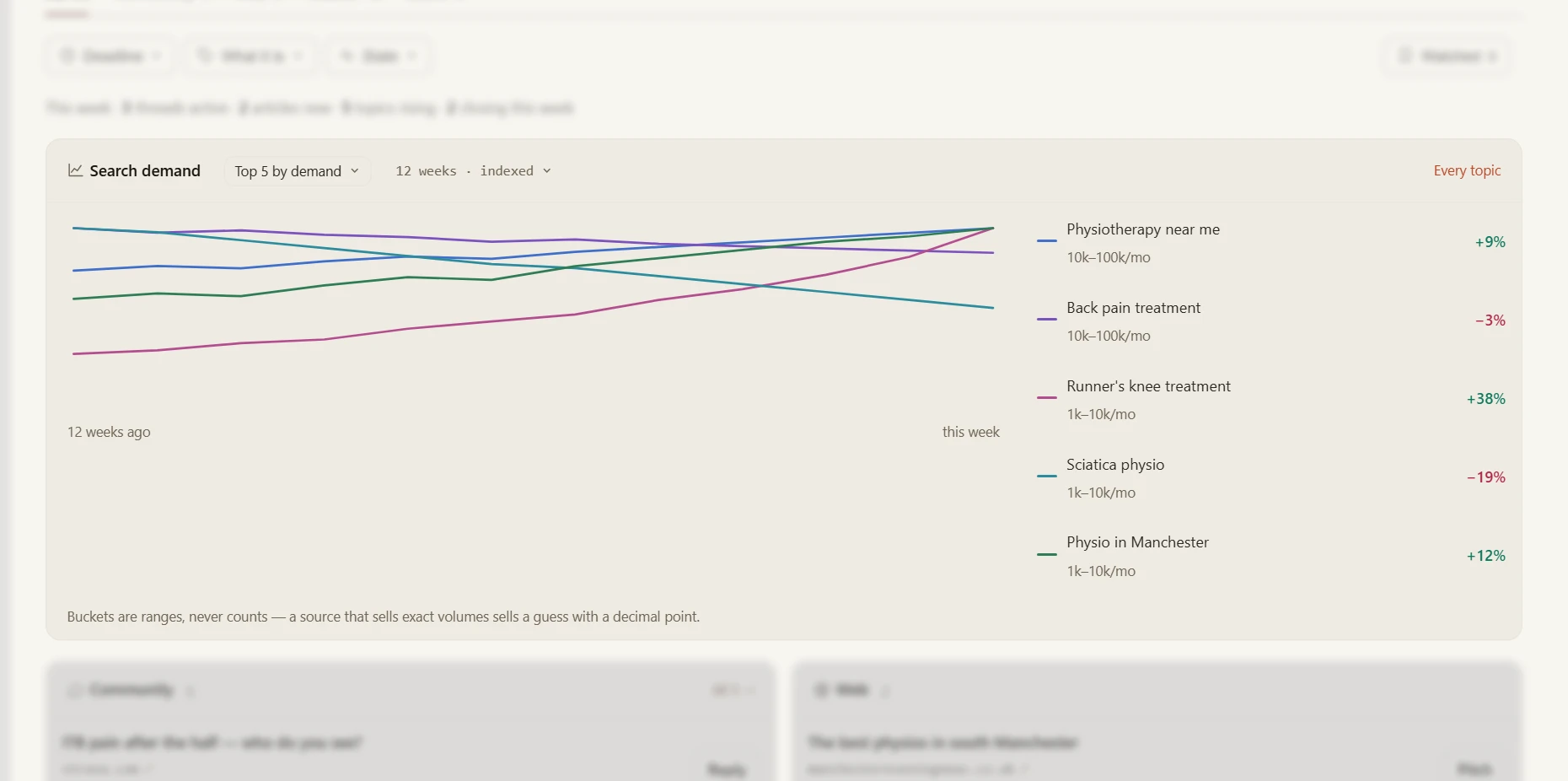
Trends is an early warning for the pages AI assistants will cite next: the article being written this week at a publisher your answers already trust, the thread people are asking in, the date that is coming. Each comes with the day it closes and the step that puts your name in it.

The pages AI assistants cite for your category keep changing: a publisher refreshes its list, a thread takes off, a date arrives. Trends watches the sources your own answers already cite and tells you when one is moving, while there is still time to be in it. It follows four kinds of signal: articles at those publishers, threads in the communities people ask in, what your market searches for, and dates you set.
Data sources shows which feeds are connected and when each was last read. A community Trends cannot read is named and marked no read access, never silently left out.
Each item carries the reason it is on your list in plain numbers — this paper’s last list is cited in 58 answers — and the day it stops being useful: this week, before the next measurement, in two weeks. You read the deadline first and decide in seconds.
| What the screen shows | Your next step | What happens | Cost |
|---|---|---|---|
| An article being written | Pitch | A pitch to the page’s editor, with the evidence attached. You send it. | — |
| A thread people are asking in | Reply | A reply as the brand, disclosed. You post it. | — |
| A question people are asking | Track | Added to the questions you measure, from the next measurement | 1 cr each |
| A topic gaining search demand | Track or Brief | Measured from the next measurement, or a brief for a new page | 1–2 cr to track |
| A date coming up | Brief | A brief with the date and the lead time attached | — |
An item with nothing useful to do about it shows no button, rather than a button that goes nowhere.
A pitch or a brief opens with the evidence attached: how often the publisher is cited, in how many answers, which competitors its last list named. It lands on your to-do list with the check that closes it, and a person sends it. The next measurement reads whether the new article names you.
The note on each item — cited 58 times, get in before the next measurement — goes with it onto your to-do list. Whoever picks it up knows why.
Pitches and replies are drafted for you and sent by a person. A thread Trends cannot read is marked as such, never counted as silence.
Tracking a question costs one credit, because it is then measured every time. Pitch, Reply and Brief cost nothing.
Trends watches the sources your answers already cite. Here is what it doesn’t do.
| It does not | What it does instead |
|---|---|
| Read every forum and social network | Reads the communities it can reach, the publishers your answers cite, a search-demand estimate and a calendar you supply; a source with no way in is named and marked no read access |
| Post or pitch on its own | Opens the reply or the pitch with the evidence attached; a person sends it and marks it sent |
| Estimate how often a question is asked of an assistant | Where search demand is shown it is a range with its source and date, labelled est., and it is search volume |
| Predict what an engine will cite | Records which publishers were cited, how often, and whether the next measurement cited the new page |
Measure your brand once, and Trends starts watching the publishers your answers cite.