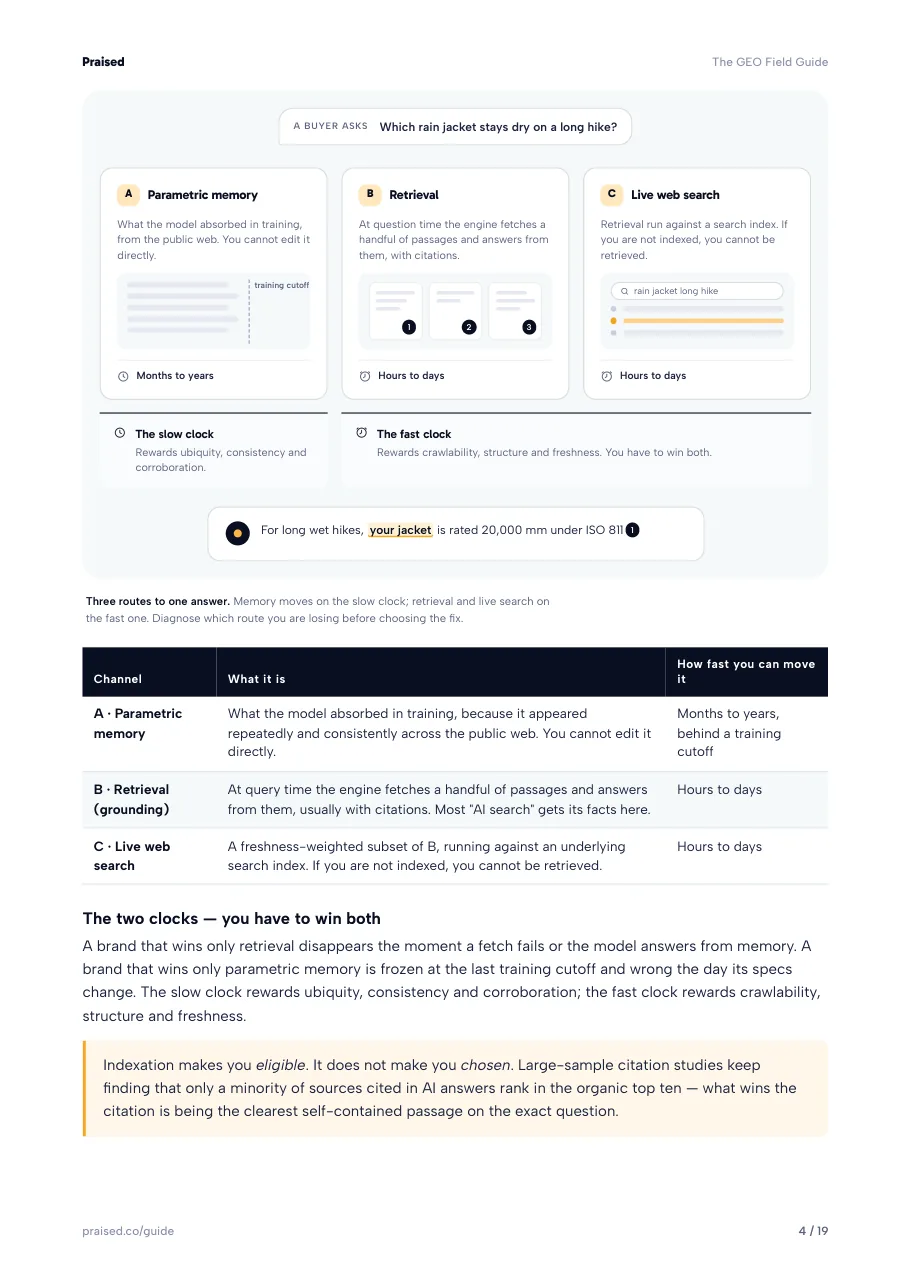
An AI tool can only mention you through one of three routes, and every
tactic in this guide maps to one of them. Diagnose the route before prescribing a fix —
most wasted GEO effort is the right work aimed at the wrong channel.
A buyer asksWhich rain jacket stays dry on a long hike?
AParametric memory
What the model absorbed in training, from the public web. You cannot edit it directly.
training cutoff
Months to years
BRetrieval
At question time the engine fetches a handful of passages and answers from them, with citations.
123
Hours to days
CLive web search
Retrieval run against a search index. If you are not indexed, you cannot be retrieved.
rain jacket long hike
Hours to days
The slow clockRewards ubiquity, consistency and corroboration.
The fast clockRewards crawlability, structure and freshness. You have to win both.
For long wet hikes, your jacket is rated 20,000 mm under ISO 8111
Three routes to one answer. Memory moves on the slow clock; retrieval and live search on the fast one. Diagnose which route you are losing before choosing the fix.
Channel
What it is
How fast you can move it
A · Parametric memory
What the model absorbed in training, because it appeared repeatedly and consistently across the public web. You cannot edit it directly.
Months to years, behind a training cutoff
B · Retrieval (grounding)
At query time the engine fetches a handful of passages and answers from them, usually with citations. Most "AI search" gets its facts here.
Hours to days
C · Live web search
A freshness-weighted subset of B, running against an underlying search index. If you are not indexed, you cannot be retrieved.
Hours to days
The two clocks — you have to win both
A brand that wins only retrieval disappears the moment a fetch fails or the
model answers from memory. A brand that wins only parametric memory is frozen at the last
training cutoff and wrong the day its specs change. The slow clock rewards ubiquity,
consistency and corroboration; the fast clock rewards crawlability, structure and freshness.
Indexation makes you eligible. It does not make you
chosen. Large-sample citation studies keep finding that only a minority of sources
cited in AI answers rank in the organic top ten — what wins the citation is being the
clearest self-contained passage on the exact question.
Entities, not keywords
Old search matched strings. Models reason over entities and the relationships
between them: a product connected to its category, its maker, its alternatives, the standards
it meets. This is why entity work is decisive in niche and B2B categories — where there is
little competing signal, whoever establishes the canonical facts first effectively writes
what every model believes.
Diagnostic: the AI tool says something wrong about us
Symptom
Channel
Where the fix lives
States an outdated spec or owner, confidently, with no citations
A
Publish the correction prominently, align third-party sources, update the knowledge graph. Expect lag.
Hedges — "reportedly", "around", "sources vary"
A
Contradiction in your own ecosystem. Find and remove it before anything else.
Names a competitor for your category question
A + B
Entity foundation, then the page that answers that actual prompt.
Describes you correctly but cites someone else's page
B
Your page is less retrievable or less clear than theirs. Structure work.
Does not mention you at all when you clearly fit
B, or a prerequisite is broken
Check crawlability first, then look for the missing page.
Right in ChatGPT, absent in Perplexity
B / C
Different indexes and crawlers. Check access per engine; never generalise from one.
Merges you with an unrelated same-named thing
A + entity
Disambiguating context in the canonical text, plus aliases and sameAs.
§2 · The order of work
The visibility pyramid
Work bottom-up. Lower layers are prerequisites. Effort spent high is wasted
while something low is broken. This ordering is the most useful thing in the guide, because
it prevents the most common failure in the field: polishing structured data on a page no
crawler can read.
Work bottom-up
Factual accuracyPrerequisiteOne set of approved facts
Crawlability and machine accessPrerequisiteA crawler can fetch and parse it
Entity foundationWhat it is, without contradiction
On-site structureWins live retrieval today
Off-site corroborationA claim becomes knowledge
Freshness and maintenanceDecay is real
Measurement and iterationNever a one-off project
Seven layers, built from the bottom. Effort spent high is wasted while something low is broken: structured data does nothing on a page no crawler can read.
0
Factual accuracy — one set of approved facts
A prerequisite. If your own surfaces contradict each other, everything downstream amplifies the
noise, and contradiction is the primary cause of a model hedging about you.
1
Crawlability and machine access
A prerequisite. If an AI crawler cannot fetch and parse the page, nothing above this line matters.
2
Entity foundation
Durable, high leverage. The model must know, without contradiction, what this is, what
category it belongs to, who makes it, and what it is not.
3
On-site structure and extractability
Durable principle, churning formats. Decides whether your true facts get retrieved cleanly
as passages. This is the layer that wins live retrieval today.
4
Off-site authority and corroboration
Durable, high leverage. A fact stated only by you is a claim; the same fact stated by
independent sources is knowledge.
5
Freshness and maintenance
Retrieval down-weights stale content and entity facts drift. Decay is real: unmaintained
pages lose visibility without anything visibly breaking.
6
Measurement and iteration
Durable principle, churning tools. You cannot manage this as a one-off project, because
the surface changes continuously.
Definition of done
A subject is not finished until every one of these is true. This list works
well pasted straight into a ticket.
One canonical URL — the undisputed home, not three competing pages.
A one-paragraph canonical definition in plain language, reused word for word across the site, the datasheet and the knowledge graph.
A machine-readable spec table — a real HTML table, with units, ranges and standards.
Structured data on the canonical page, with sameAs to authoritative profiles.
Crawlable to the AI agents you care about — or a deliberate, documented decision otherwise.
An HTML version of every datasheet's key facts.
A visible question-and-answer block in question → direct-answer form.
At least three independent sources stating the same category and the same numbers.
A named owner and a review date.
§3.1 · Gate 1
Can a crawler actually read it?
Most AI crawlers do not execute JavaScript. They read the raw
HTML your server sends. Every fact you want cited has to exist as text in view-source — not
only in an image, a chart, a PDF, or content that loads on click.
The evidence is Vercel and MERJ's December 2024 measurement, the only
large one we found: the OpenAI, Anthropic, Meta, ByteDance and Perplexity crawlers did not execute
JavaScript; Google's (Gemini, through Googlebot) and Apple's did. Design for the strictest
reader, not for the most capable one. A client-rendered single-page app is close to
invisible to AI tools however good its content is.
In a browser
Summit Shell rain jacket
SpecsFitCare
Read moreSpec sheet.pdf
In the raw HTML
Summit Shell rain jacket
The comparison chart: an image, no text in the source.
Fit and Care tabs: loaded by script, not in the source.
The waterproof rating: only in the PDF and behind “Read more”.
Read the raw HTML only
OpenAIAnthropicPerplexityMetaByteDance
Also run JavaScript
Google (Gemini, through Googlebot)Apple
The same page, as two readers get it. Every fact you want cited has to be text in view-source. Crawler behaviour from Vercel and MERJ’s December 2024 measurement.
Forbidden
Fine
Specs only in a PDF
Native <details> — the text stays in the source
A comparison shown only as an image
Server-rendered tabs with every panel in the HTML
Answers that expand by fetching over AJAX
Real <table>, <ul> and <dl>
Any "read more" that loads text after a click
Inline SVG containing real text
Verify it — do not assume it
View source with JavaScript off and search the raw HTML for the definition sentence, each headline number, each answer, each comparison value.
Check the status code and that nothing sits behind a consent wall, geo-block or login for the crawler.
Fetch robots.txt and enumerate which AI agents are allowed, and whether a Sitemap: directive exists.
Confirm the sitemap is current and lists the canonical URLs.
Confirm the canonical link, and that variants point at the hub.
Confirm the page is indexed in the underlying search engines — live retrieval depends on it.
Our free AI crawler access checker does the
robots.txt parse and the live per-agent probes for you, including the CDN and firewall blocks
that robots.txt alone will not reveal.
The robots.txt decision is two decisions
Conflating them is the most expensive mistake in this section.
Search and answer agents
Bulk training crawlers
What they do
Fetch pages to build the answer a user gets now, and to power the engine's index. Usually produce a citation.
Collect corpora for training the next model.
Blocking means
You disappear from AI answers.
Your content is less likely to enter parametric memory.
Decision type
A visibility decision — for most vendors, allow.
A licensing decision — declining is defensible.
Two further rules worth holding: robots.txt is a request, honoured by
reputable crawlers, not an enforcement mechanism — if you need actual prevention, that is
authentication or edge rules. And blocking is hard to reverse in effect, because lost presence
takes time to rebuild. Ready-made rules are in the
templates pack.
§3.2 · Layer 2
The entity foundation
The model has to be able to answer, with no contradiction: what is it, what
category, who makes it, what is it not, and what is it the same as. This is the
highest-leverage durable work available, and it is mostly unglamorous.
The most valuable string you control
NameNameis aCategorycategorymade byMakerMakerthat doesWhat it doesYforFor whomZ.
Your siteThe first sentence of the canonical page
The datasheetIts opening line, in HTML too
WikidataThe item’s description, referenced
Directories and partnersTheir profile of you
Legacy nameKept as an alias and an alternateName, so a rebrand does not split you in two.
Same name, different thingDisambiguating context in the canonical text keeps you from being merged with it.
One sentence, said the same way everywhere. The model has to answer what it is, what category, who makes it and what it is not, with no contradiction between your surfaces.
State the full name, category and maker in the first sentence, everywhere. The pattern is "Name is a category made by Maker that does Y for Z". This single repeated sentence is the most valuable string you control.
Resolve legacy and alias names explicitly. After a rebrand, models trained across the transition hold conflicting facts. Record the legacy name as an alias and an alternateName, and let the machine-readable layer carry the bridge, and the running copy stays clean.
Handle name collisions. Search your name in isolation. If unrelated things share it, your canonical text needs disambiguating context to keep entity linking from merging you with them.
One spelling and casing, consistently, with the variants recorded as aliases.
The open knowledge graph, in order of effort
Wikidata first — structured, editable, and it feeds both training corpora
and grounding systems. Give every statement a reference; unreferenced statements are low-trust
and prunable. Add multilingual labels, because one item serves every language.
Wikipedia second, and slowly: a standalone article needs notability established by
independent sources you do not control, and a promotional page will be removed and can
backfire. Build the independent-source base first.
Do not make covert promotional edits, cite your own marketing as a
notability source, or create an article before independent coverage exists. Disclose conflicts
of interest and propose sourced edits transparently. This is one of the few places in GEO
where the shortcut has a real downside.
sameAs — wiring the entity together
In the canonical page's structured data, sameAs should point at
every authoritative profile of the same entity: Wikipedia, Wikidata, official social profiles,
industry registries, standards listings. It is the literal machine instruction "these all
refer to the same thing". Cheap, durable, and left out more often than anything else on this
page. Our schema generator emits it correctly.
§3.3 · Layer 3
Structure and extractability
Engines retrieve passages, not pages. A page is a container; the unit that earns
a citation is a paragraph that makes sense on its own.
Your page
Summit Shell rain jacket
How waterproof is it?
Which standard is it tested to?
Does it fit over a fleece?
The answer
1your page, “How waterproof is it?”
The heading is the question phrased the way a buyer asks it.
The answer comes first, then the support.
It names the subject, never “it” or “the platform”.
50 to 150 words, and it makes sense with nothing around it.
Engines retrieve passages, not pages. The unit that earns a citation is one section that answers one question on its own, lifted whole into the answer.
Self-contained sections of roughly 50–150 words, each answering exactly one question under a descriptive heading.
No orphan pronouns. A retrieved paragraph must make sense with zero surrounding context — repeat the subject's name instead of "it" or "the platform".
One idea per paragraph, one claim per sentence, conclusion first, support after.
Put the direct answer immediately under the question heading, then elaborate.
Front-load the page. A disproportionate share of citations come from the top, and the top is what survives truncation. The definition goes above the narrative.
Self-contained, not fragmented. There is no requirement to chop content
into tiny pieces, and doing it causes cannibalisation — a supporting page out-ranking and
out-citing the page it supports. The target is complete and self-contained.
Semantic HTML
One clear <h1> carrying the canonical name and category, with
a logical heading hierarchy phrased as real user questions. Real tables for specs and
comparisons, lists for steps, definition lists for term-and-definition pairs. Valid HTML, a
set lang, a descriptive title and an answer-first meta description of about 155
characters. Native <details> for progressive disclosure — never a
JavaScript accordion that fetches its own text.
Structured data
Structured data is the most reliable way to hand a machine unambiguous facts. It
is not a ranking lever — Google states it is not required for AI features — but it is cheap,
durable and it disambiguates. Mark up the primary entity, the organisation behind it, the
breadcrumb trail, and any visible question-and-answer block, and make sure every marked-up
fact appears in the visible text. Structured data that contradicts the page is worse than none.
Media, PDFs and datasheets
PDFs are weakly retrievable: often poorly chunked, sometimes not crawled at all,
with the real numbers trapped in tables and figures. This matters enormously in B2B, where the
facts live in datasheets.
Mirror every datasheet's key facts in HTML. The PDF can stay the formal artifact; the HTML is what gets retrieved.
Never put a number only in an image. Restate it in adjacent text, or use inline SVG with real text plus a caption carrying the values.
If a PDF must stand alone, give it selectable text, a descriptive filename, a title, headings, a stable URL and an HTML landing page that summarises and links it.
Express every spec with its units and qualifiers inline. "20,000 mm, tested to ISO 811" beats "fully waterproof", and models reproduce the qualifier when it sits beside the number.
llms.txt — the honest verdict
A proposed convention: a Markdown file at the site root pointing at your most
citable pages. Google says Search does not use it, no engine documents reading it, and Chrome's
experimental Lighthouse audit checks for one; it may standardise or fade. Cheap and
harmless, not shown to change citations. Ship it if
it costs an hour, and never let it substitute for robots.txt, a sitemap, structured data or
HTML hygiene. Our llms.txt generator builds one from your
sitemap.
Hub and spoke
The canonical page is the hub; focused spokes each own one question and link
both ways. Engines read the internal-link graph to decide which page is the citation-worthy
source. Route links and authority toward the hub with descriptive, varied anchor text —
never "read more" alone. Contextual in-body links carry more signal than the same link in a
related block; do both, but do the in-body one. Roughly three to five internal links per
thousand words, key pages within about three clicks, no orphans.
§3.4 · Layer 4
Off-site corroboration
A fact stated only by you is a claim. The same fact stated by
independent sources is knowledge.
Corroboration is how a claim enters parametric memory and earns retrieval trust.
In specialised categories it is decisive, because whoever seeds consistent independent facts
first owns the model's understanding. Ordered by trust:
Ordered by trustWhat it states
Standards bodies and official registers Highest authority, hard to fake20,000 mm
Peer-reviewed and preprint literature Ages extremely well20,000 mm
Independent technical and trade press Vertical publications20,000 mm
Review and directory platforms Accurate third-party profiles15,000 mm
Communities and forums Be genuinely present; never astroturf20,000 mm
Only your site says it
“Rated 20,000 mm.”
A claim. The same fact stated by independent sources is knowledge.
Every source says the same
“The waterproof rating is 20,000 mm.”
One source differs
“The rating is reportedlyaround 15,000 to 20,000 mm.”
Divergent numbers across sources are the leading cause of a model hedging on a technical subject.
The durable principle is consistency. Each independent source should repeat the same definition and the same numbers; one that does not is enough to make the answer hedge.
Standards bodies and official registers — classifications, metrology institutes, regulators. Highest authority, durable, hard to fake.
Peer-reviewed and preprint literature that names the subject. For technical products this is the dominant channel and it ages extremely well.
Independent technical press and vertical trade publications.
Review and directory platforms — accurate third-party profiles raise citation probability.
Communities and forums, which some engines cite disproportionately. You cannot astroturf this; you can be genuinely present.
The aggregate charts are easy to misread. Published analyses disagree on
which sources lead: some put Reddit, Wikipedia and YouTube near the top, and Profound's 2026
analysis of 11.84 billion citations found brand-owned sites the largest source overall. The mix
differs by engine and moves month to month, and none of it is a statement about your category. For a specialised B2B subject the cited
sources skew heavily to standards, literature and vendor documentation. The actionable reading
is about format: what those platforms have in common is that they are independent,
question-shaped, plainly written and densely factual. That is a description of what to make
your own content look like.
The durable principle is consistency. Every corroborating source should
repeat the same definition and the same numbers. Divergent numbers across sources are the
leading cause of model hedging on technical subjects.
§3.5 · Layer 5
Freshness and decay
Keep dateModified accurate and show a visible "last updated" date.
Date your facts in the prose — "as of 2026, the current model is…" — and a stale claim is self-evident.
Do not fake freshness. Bumping a date with no substantive change is a low-trust signal, and it destroys your own ability to read measurement deltas afterwards.
Run a propagation pass on the triggers: a new model or spec, a rebrand or acquisition, a new engine launch, or a measured accuracy drop. Update the facts, then push them to the site, the structured data, the knowledge graph and your partners within one sprint.
When one of these happens
A new model or spec
A rebrand or acquisition
A new engine launches
A measured accuracy drop
Update the facts once
Current modelAs of 2026, …
Waterproof rating20,000 mm
StandardISO 811
Dated in the prose
Then push them to
Your sitevisible “last updated”
Structured datadateModified
Knowledge graphWikidata
Partnerstheir profiles
within one sprint
Updated 3 March 14 OctoberA date bumped with no real change is a low-trust signal, and it ruins your own before-and-after readings.
A propagation pass. Unmaintained pages lose visibility without anything visibly breaking; a trigger starts one pass that carries the new facts everywhere they are stated.
§4 · Playbook B
Deciding what to write
A beautifully structured page that answers the wrong question will not get
cited. Models cite the page that best matches the intent behind a prompt. If nobody mapped
the prompts, the team is guessing at intent — and whoever did map it gets cited instead.
ProfilesA specific decision-maker, not a market
JobsThe decisions they are accountable for
QuestionsIn the buyer’s words, from sales and support
PromptsTyped the way an AI tool hears it: your measurement suite
Baseline testRun the suite before changing anythingThe step most teams skip
Content mapEach prompt to the element that answers it
BuildThe page work
MeasureRe-run the same suite and compare
The same versioned suite, every round
Learn questionsan explainer page
Decide questionsthe product page
Act questionsthe contact route
Map the questions before anyone writes. The prompts become the suite you measure with, so the baseline you skip is the proof you cannot show later. Route each question by stage: a page serving all three usually serves none.
Two governing principles. Content is evidence, not persuasion: buyers in
considered purchases verify rather than get sold, and a page of adjectives loses to a page of
numbers and standards. And route by stage — learn questions to explainer pages,
decide questions to the product page, act questions to the contact route. A
page serving all three usually serves none.
Step
What it produces
1 · Profiles
A specific decision-maker, not a market segment. "Logistics" is a market; "a warehouse operations lead who buys through a systems integrator" is a profile — and they ask different questions.
2 · Jobs
The decisions each profile is actually accountable for.
3 · Questions
The real questions, harvested from sales calls, support tickets and the search box — in the buyer's words, not yours.
4 · Prompts
Those questions rewritten the way someone would type them into an AI tool. This becomes your measurement suite.
5 · Baseline test
Run the suite before you change anything. This is the step almost every team skips, and it is why most GEO efforts cannot prove anything later.
6 · Content map
Each prompt mapped to the page element that answers it — a section, a table, an FAQ entry, a new spoke.
7 · Build
Hand off to the page work below.
8 · Measure
Re-run the same versioned suite and compare.
In the PDF
The part you act on is in the PDF.
The first eight chapters are on this page. The last five are the playbooks: the checks a page passes before it ships, the order to audit a site in, and how to measure the result without fooling yourself.
Building the pageThe twelve-point ship-it check, the invisible layer, and the rules for every page.
Gating without going invisibleWhen asking for an email is a fair exchange, and when it hides you.
Measuring without fooling yourselfThe metrics that matter, the statistics behind them, and attribution.
The audit, bottom-upThe order to audit a site in, and when to stop and report.
Myths you will hearNine claims you will hear in meetings, each corrected with the mechanism.