Free tools · llms.txt generator
Build your llms.txt file.
The llms.txt generator writes the Markdown file that points AI models to your most important pages. Name your company, choose your key pages and copy the file.
Free · save the file as /llms.txt at your site root.
4 key pages suggested from the sitemap
Save as /llms.txt at your site root
Choose your pages
Pick the pages that answer buyers, then group them.
A short, curated list beats a sitemap dump. Keep the pages that answer buyer questions: pricing, how the product works, security, comparisons and your best guides. Leave out archives, logins and anything that changes weekly. Group the pages under ## headings, with nice-to-have pages under ## Optional, the section models may skip when space is short.
clauseminds.com/sitemap.xml
- /pricing## Product
- /how## Product
- /security## Trust
- /guides/contract-obligations## Guides
- /blog/tag/contractsArchive page
- /blog/2024/05/team-offsiteCompany news
- /loginBehind a login
- /changelog?page=7Paginated, changes weekly
/llms.txt
# ClauseMinds> AI contract review for small law firms: flags risky clauses and tracks obligations after signing. ## Product- [Plans and price per seat](https://clauseminds.com/pricing)- [How the review works](https://clauseminds.com/how) ## Trust- [Data hosting and security](https://clauseminds.com/security) ## Guides- [Tracking obligations after signing](https://clauseminds.com/guides/contract-obligations)Describe each page by the answer the page gives, not its title: “Plans and price per seat”, not “Pricing”.
Where the file fits
Last in line at your site root.
The file points engines to your pages; the pages still have to be readable. Crawlable server-rendered HTML comes first, then robots.txt and a sitemap, then schema, then llms.txt.
clauseminds.com /
- index.htmlCrawlable, server-rendered HTMLFacts in the page itself, not locked in JavaScript or PDFs.Check a page
- robots.txtrobots.txt and a sitemapLet the answer crawlers in, and tell them where everything is.Check crawler access
- sitemap.xml
- <head> JSON-LDSchemaThe facts marked up for engines to extract cleanly.Build the JSON-LD
- llms.txtThen llms.txtA short index of your canonical pages for AI models.
What to expect from the file
A small file with a small job.
- Google says Search doesn’t need one. The file neither helps nor harms a page in Google Search.
- No major engine documents reading llms.txt yet. AI companies publish the file for their own docs; none commits to reading yours.
- The file never substitutes for robots.txt, schema, a sitemap or crawlable HTML.
Cheap and harmless, not shown to change citations. The file doubles as a tidy index of your canonical pages. Adoption may standardize or fade: publish the file alongside the work that matters more, never instead of that work.
After the file, check the pages on the list.
An llms.txt tells engines where to look. Whether they can read those pages is the bigger question, and whether they cite you is the one that counts.
-
Check crawlers can fetch the pages
robots.txt read per crawler, and real requests to catch the CDN rule.
Check AI crawler access -
Check each page is ready
Readiness to be found, understood and cited, factor by factor.
Check a page free -
Mark the facts up
Product, FAQ, Organization and Article JSON-LD, ready to paste and check.
Build the JSON-LD -
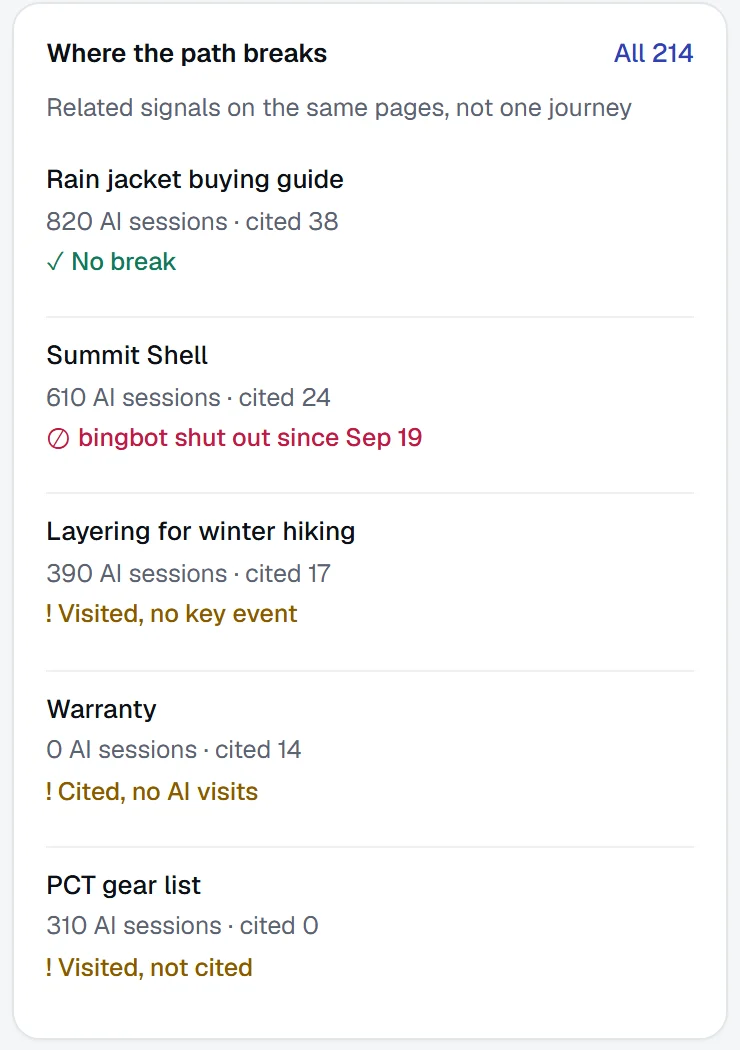
Find which pages AI actually reads
Crawler requests, citations and visits per page, and where the path breaks.
Explore AI traffic & conversions
More free tools.
All free toolsQuestions, answered.
Something else on your mind? Contact us.
It is not shown to. The file is cheap and harmless, not shown to change citations, and no engine documents reading it. Whether engines cite your pages depends on what the pages say.
No. The file never substitutes for robots.txt, schema, a sitemap or crawlable HTML.
At your site root, as /llms.txt, served as a plain text file. Update the file when a key page moves or a new one launches.
Yes. Edit any field and the file rebuilds as you type. Start a line with ## to add a group, and copy the result when everything reads right.
An llms.txt tells engines where to look.
Whether they can read those pages is the bigger question, and whether they cite you is the one that counts. Check both, free.