A number nobody sees changes nothing.
Integrations are the ways a number leaves the console: REST API, MCP server, Slack and email digests, CSV and PDF exports, CMS publishing, and SSO.
Integrations are the ways a number leaves the console: REST API, MCP server, Slack and email digests, CSV and PDF exports, CMS publishing, and SSO.
Integrations and API is how Praised data leaves Praised: a REST API with scoped keys, an MCP server for assistant clients, Slack and email digests after every scheduled run, CSV and PDF exports, direct CMS publishing, and OIDC single sign-on you configure yourself. A visibility number only changes behaviour if it reaches the meeting where decisions get made, and that meeting is rarely held inside our console. Pull it, get it pushed to you, or ask an assistant about it. Same data, same permissions.
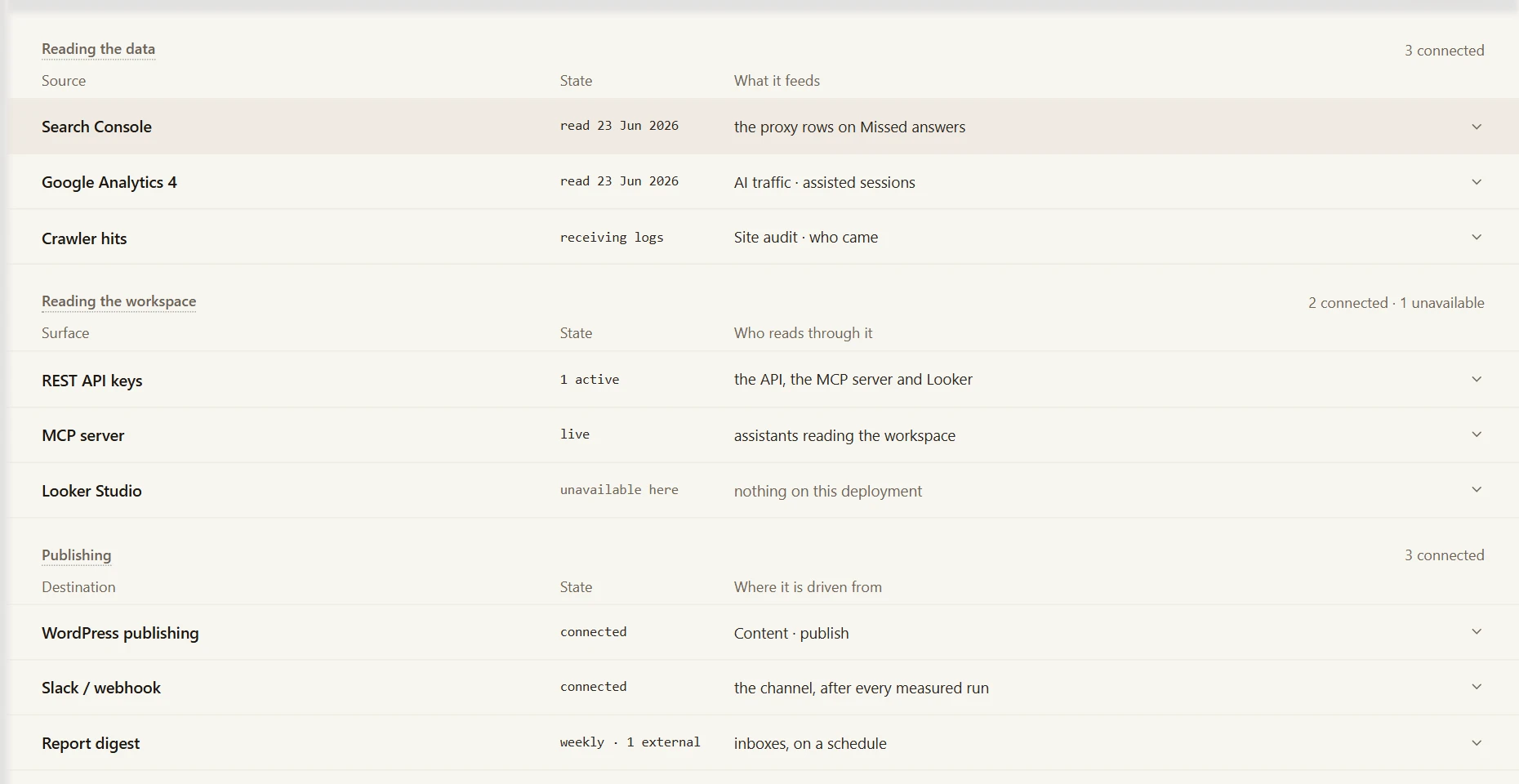
Runs, per-prompt results, citations, competitors, experiments and the action queue — all readable with a workspace-scoped key you create and revoke yourself.
Enough to build your own dashboard, feed a warehouse, or wire visibility into an internal scorecard.
On every paid plan, from $99. No enterprise gate, no access request: name a key in Settings → API keys and it is live.
Point Claude, Claude Code or any MCP client at the server and ask your own data questions in plain language — which prompts slipped, what is open in the queue, what changed since last run.
Twenty-two tools: eighteen read — the measurements, the approved facts, the format contracts — and four work the queue or hand a draft back. All under your own token, scoped to what you can already do.
A summary posted to your Slack channel or webhook after every scheduled run, drift alerts when a tracked rate moves beyond its interval or a rival overtakes you, and an email digest on the cadence you choose.
Slack delivery is a webhook URL you paste once — no app to install, nothing to grant.
All of it ships on every paid plan, and none of it needs asking for. There is no integrations tier: what separates the plans is credits and how many products you track, not which doors we unlock.
Six answer surfaces, none plan-locked — credits are the only limit.
One MCP server, 22 tools, any MCP client — write where you already work, ground and grade it here.
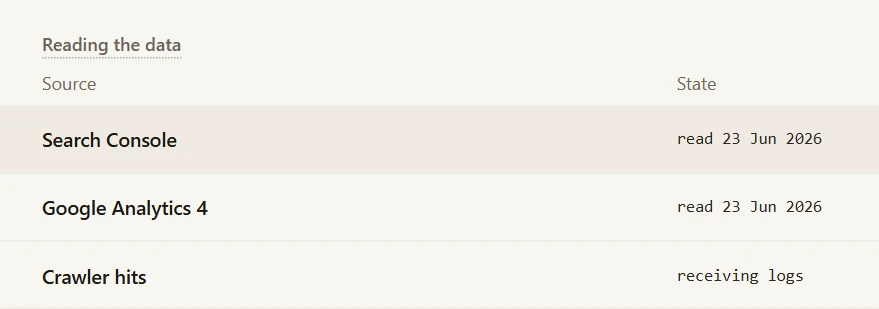
Search demand and AI-referred sessions synced daily; AI-crawler hits shipped from your edge with a copy-paste snippet.
A summary on your channel after every run; the digest to whoever the report is for — including people without a login.
Three CMS connectors that write drafts and only drafts — plus clean exports for everything else.
The REST API and CSV feed any BI tool today; the Looker Studio connector is in final checks before its gallery listing.
Self-serve OIDC and SAML — issuer, certificate, domain allowlist. No sales call to turn either on.
Every item, every paid plan — see pricing for what does differ (credits and tracked products).
A workspace per client, credits pooled across all of them, and a portfolio view that ranks every brand you manage on one screen.
One subscription covers the roster rather than one per client, so the credits follow the work instead of the invoice. How agencies run it →
Nothing, to start. No tag, no script, no DNS record, no CMS connection. Measurement reads the public web the way an engine does, so a first run needs only a domain.
Connections exist to remove steps later — publishing without a copy-paste, alerting without a check-in — never as a prerequisite for the number.
The API is a key away and the digests are a checkbox. These two live outside the console, so here is the whole setup.
Point Claude Code, Claude Desktop, Cursor or any MCP client at it and ask in plain language. Twelve tools read the measurements; three work the fix queue.
claude mcp add praised \
  --env PRAISED_API_KEY=<your key> \
  -- npx -y @praised/mcp-server
The key comes from Settings → API keys and does not expire; revoking it cuts the integration off at once. It is traded for a short-lived token behind the scenes, so nothing permanent travels to the measurement API.
Everything runs under your own token, scoped to what you can already see and do. Marking an action fixed triggers an immediate re-check, and a finding that is still there goes back on the queue — an assistant cannot mark its own homework.
One row per metric per run, with the interval bands intact, in the report you already send. The connector is built and in final checks before its gallery listing; until that lands, the REST API and CSV export feed Looker Studio through its native connectors.
Run date · Metric · Run ID · Change beyond noise · Value · CI low / CI high (95%) · Sample size (n) · Delta vs previous run
/v1 endpoints into Looker Studio's Sheets or CSV connectors with a key from the same place.A missing interval stays empty rather than becoming a zero — a chart should never draw certainty we did not measure.
Start free, connect what you need later. The first run asks for a domain and nothing else.