Skip to content
Pricing
Get started free
HomeProductPerception

Know what AI tells buyers about your brand.

Perception is the way to know what AI assistants tell buyers about your brand: the sentences they repeat, the claims your own facts contradict, and the places they aren’t sure. You catch the wrong description before a customer reads it.

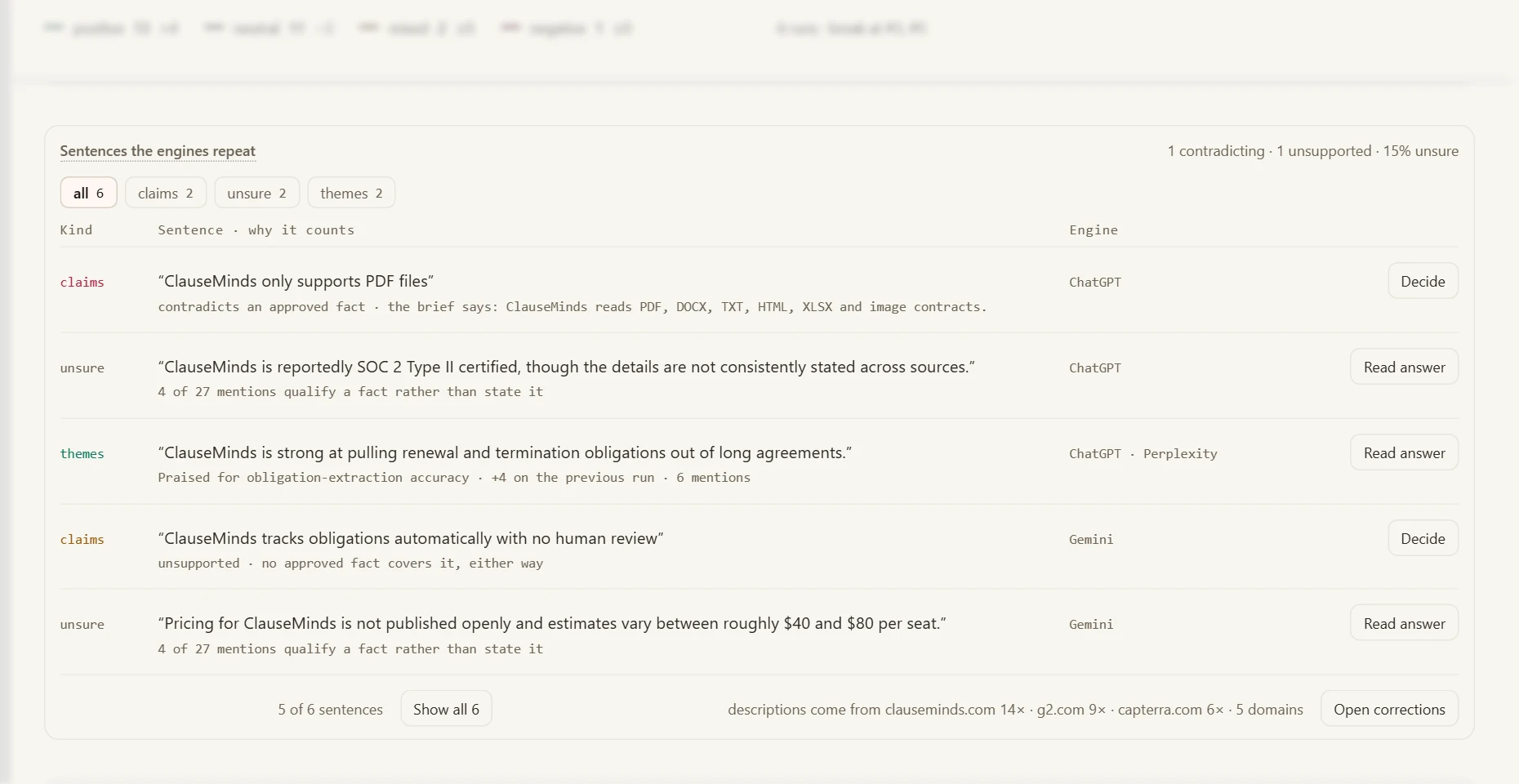
The Perception screen: the list of sentences the engines repeat in focus, with filters for claims, unsure and themes and rows of kind, sentence and engine, under the tone chart out of focus.
The sentences AI repeats about you, each marked against your own facts.

Know how you’re described, at a glance

Four readings tell you whether the description is working for you or against you. The example workspace: net sentiment +44, the most positive of five brands; engines unsure 15%, hedging in 4 of 27 answers; 1 unsourced claim; and no missed categories, with 5 of 8 discussed.

Catch the wrong sentence before a customer reads it

Every sentence the engines hold about you, sorted into claims, hedges and the themes they keep coming back to. A claim is checked against the facts you approved: contradicted if your record disproves it, unsupported if your record is silent. Open any sentence to read the answers it came from.

The sentences list on the example workspace: a claim that contradicts an approved fact, marked with the engine that carried it; an unsure sentence; a theme; and a claim no approved fact covers.
Example dataA claim your facts disprove is marked contradicted; one your facts don’t cover is unsupported. They are never added into one alarm.
What the screen showsWhat it isWhat it’s checked against
ClaimA statement of fact about you: a price, a feature, a personYour approved facts. Contradicted if they disprove it; unsupported if they don’t cover it
UnsureA hedge: the engine said may, appears to, is reported toCounted as the engines being unsure; a hedge is not filed as a claim
ThemeA description the engines keep using: a simpler alternative to HubSpotHow often it appeared this time against last time, and whether that changed

Under the list, the sites the descriptions come from. One engine saying it once is an engine talking; several engines saying it is what the web says about you.

Act on the words, not the mood

Sentiment is easy to headline and hard to act on. One real workspace read 293 positive mentions and 0 negative, and learned nothing it could do. A wrong price repeated in four answers tells you exactly what to fix. Perception leads with the sentences and keeps sentiment as one reading beside them.

Categories you’re missing from

The kinds of questions buyers ask about your category where you are never named, beside how many were discussed at all.

Checked against your facts

Claims are read against the facts you approved. When your record doesn’t hold the fact, the claim reads not checked, never clean.

Did it change

Every reading and every theme shows its change since the last measurement, and whether it is real or within noise.

What it does not do

Perception reads the language in a sample of AI answers. Here is what it doesn’t do.

It does notWhat it does instead
Measure public moodReads the answers the engines gave to your tracked questions; sentiment is a reading of that language, not of a market
Headline a sentiment scoreLeads on the sentences the engines repeat and the claims that contradict your facts; sentiment is one reading
Make an engine retract a sentenceTraces the sentence to the page that feeds it, drafts the correction, and measures whether the next answers still carry it
Pass a judged reading as human-validatedPublishes the judge’s agreement with hand-labelled answers on the methodology page, and marks unlabelled readings as not human-validated

Fair questions

What counts as a wrong claim?
A claim is read against your approved facts. Contradicted means your record disproves it; unsupported means your record neither confirms nor denies it. They are reported as two findings, and a check that needs a fact your record lacks is reported as not checked.
Why is net sentiment not the headline?
Because tone is a weak signal that looks strong. A wrong price in four answers tells you what to do; a net score does not. Sentiment is one reading, and the sentences it came from are on the same screen.
How is sentiment scored?
By a judge reading each answer that names you, checked against hand-labelled answers; the agreement is published on the methodology page. Net sentiment is positive minus negative, of the answers naming you, with the neutral share printed beside it.
Can it tell me how my category is described?
Yes. Themes are read for every brand you track and for the category, with how often each appeared and how that changed. The sentence a competitor owns is as useful as the one you do.
Keep going

Read what AI repeats about you.

Measure your brand once, and Perception lists every sentence, checked against your facts.