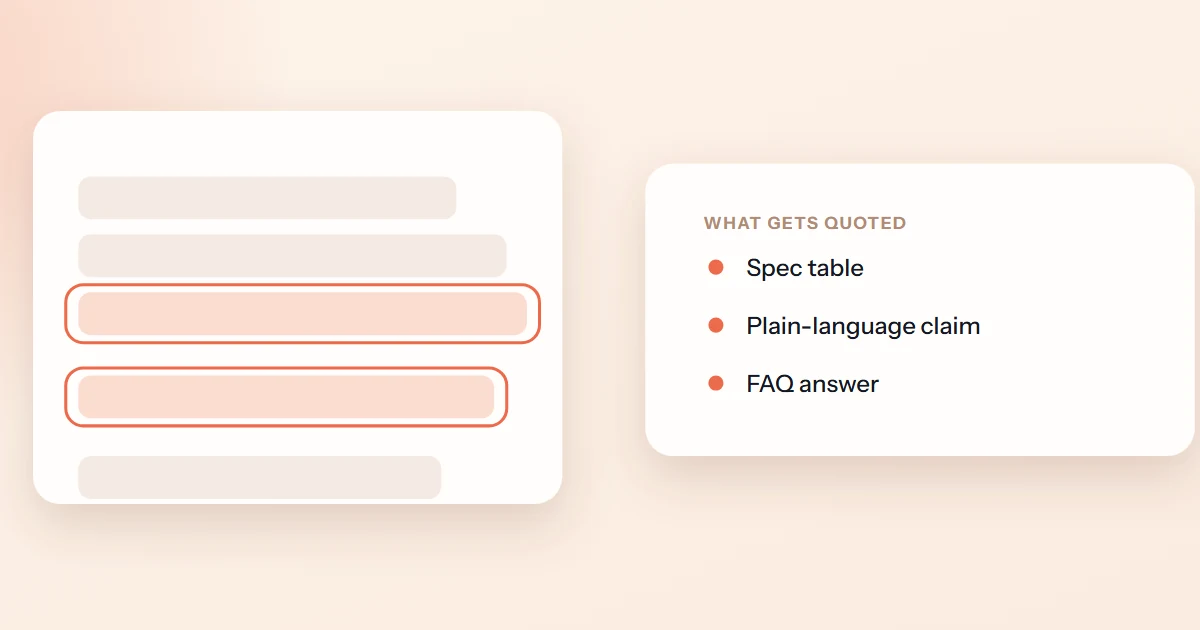
- FAQ content mirrors the question→answer structure of an AI response, making it unusually easy to extract and quote.
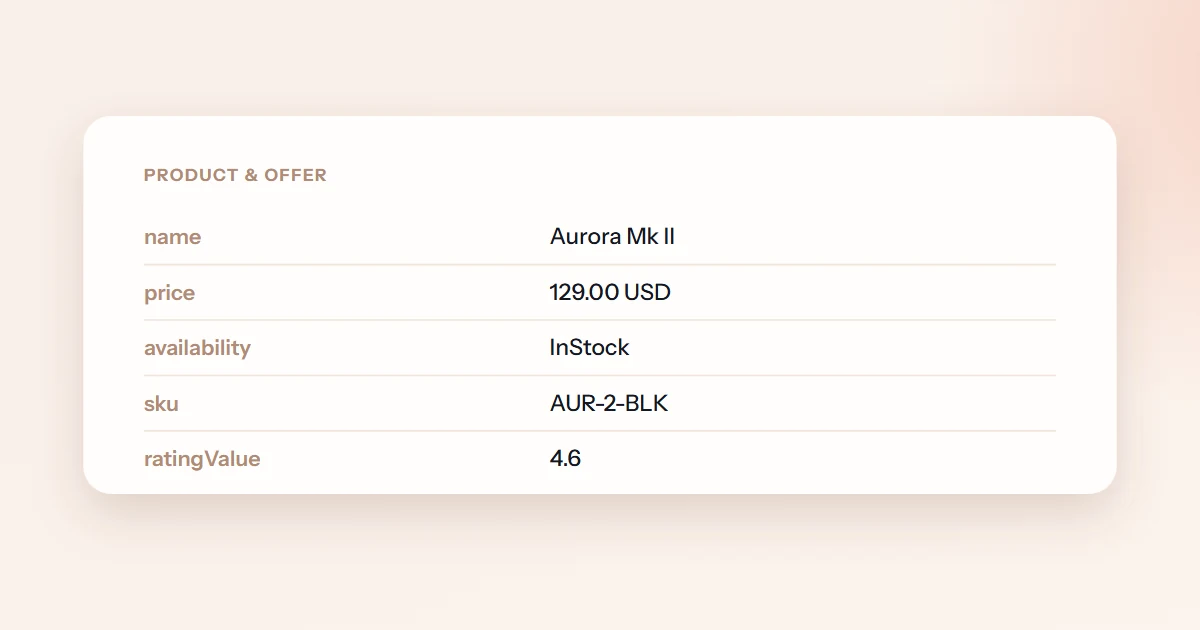
- FAQPage schema labels the pairs for machines. Optional: Google retired FAQ rich results in May 2026, and no engine documents reading the markup for answers.2
- The wins come from using real buyer questions and writing self-contained answers — not keyword-stuffed filler.
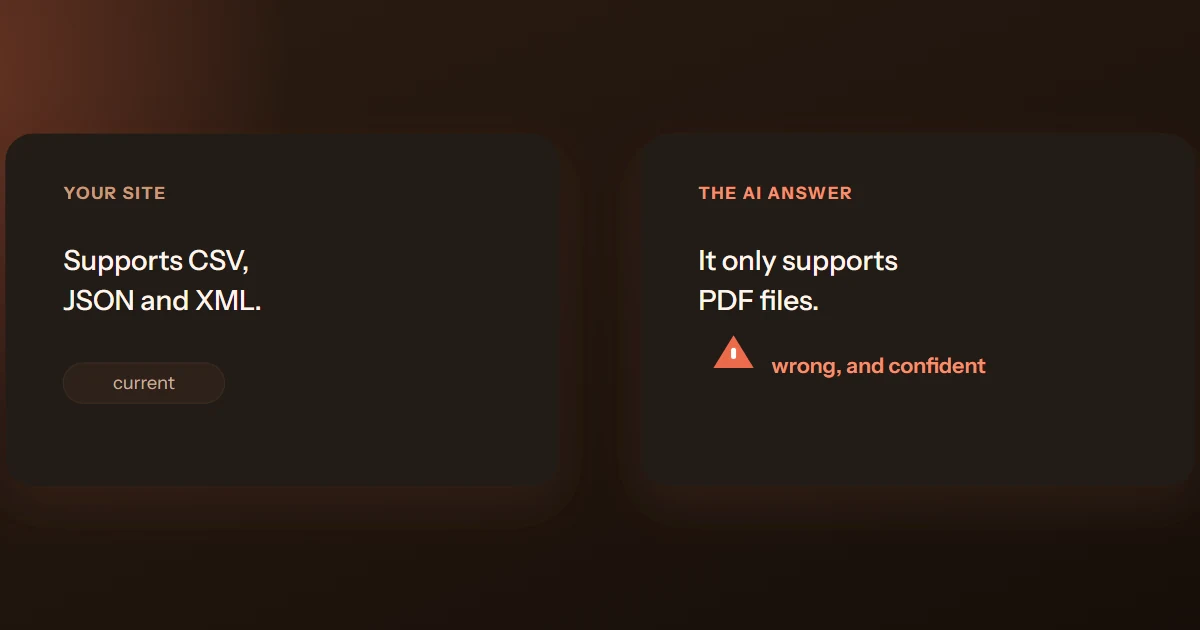
- FAQs are also your fastest fix for recurring inaccuracies: answer the misconception directly and correctly.
Most FAQs are an afterthought — a dumping ground for questions nobody asked, answered in a sentence fragment. That’s a missed opportunity, because a good FAQ is the single most quotable format in your content library.
Why FAQs are so quotable
An AI answering a buyer question is doing retrieval-then-synthesis. When it finds a page that already contains that exact question with a clean answer beneath it, the synthesis step is nearly free — it can lift your answer with minimal transformation. Low transformation effort is strongly associated with getting cited and attributed correctly.
The test for a good FAQ answer: could it stand alone, pasted into a chat, with no surrounding page? If it needs the rest of the page to make sense, an AI tool can’t cleanly lift it — rewrite it to be self-contained.
Writing answers models can lift
- Use the real question, in the buyer’s words — mine support tickets, sales calls and search queries.
- Answer in the first sentence; add nuance after, not before.
- Make each answer self-contained — include the noun, not just “it.”
- Attach a number or source where relevant — specifics get quoted, adjectives don’t.1
Mark it up
Optionally, wrap the Q&A in FAQPage schema that mirrors the visible text. The visible pairs carry the weight; the markup labels them:
{
  "@context": "https://schema.org",
  "@type": "FAQPage",
  "mainEntity": [{
    "@type": "Question",
    "name": "Does it work offline?",
    "acceptedAnswer": {
      "@type": "Answer",
      "text": "Yes — measurement runs fully offline; syncing requires a connection."
    }
  }]
}
FAQs as accuracy repair
If AI tools keep repeating a wrong belief about you — a discontinued limitation, a misremembered price — an FAQ is your most direct fix. State the misconception as the question and correct it plainly in the answer. Because the format is so liftable, the correction propagates faster than buried body copy.
Your FAQ is the one place you get to write the answer before the model does. Write it like you want to be quoted.
A quick FAQ upgrade plan
- Collect the 15–20 questions buyers actually ask, in their words.
- Rewrite each answer to lead with the answer and stand alone.
- Add a number or source wherever you can.
- Optional: FAQPage schema matching the visible content.
- Add any recurring AI misconception as an explicit, corrected question.
Frequently asked questions
No. Google stopped showing FAQ rich results on May 7, 2026. The visible questions and answers still matter, because engines read and quote the page itself; the FAQPage markup is optional. Build FAQs for the answer, not the rich result. To find out what Google is showing in place of one, run the question through a free AI Overview check.
Enough to cover the genuine buyer questions and no filler — usually 10 to 25. Padding with invented questions dilutes quality and risks marking up content nobody needs.
Often, yes — it’s the most liftable place to state a correction. Phrase the misconception as the question and answer it accurately; because the format extracts cleanly, the fix tends to propagate faster than body copy.
Sources & further reading
- "GEO: Generative Engine Optimization", Aggarwal et al., KDD 2024 / arXiv:2311.09735.
- Schema.org vocabulary — Product, Offer, FAQPage, Organization types.
- Google — "Product structured data" reference.