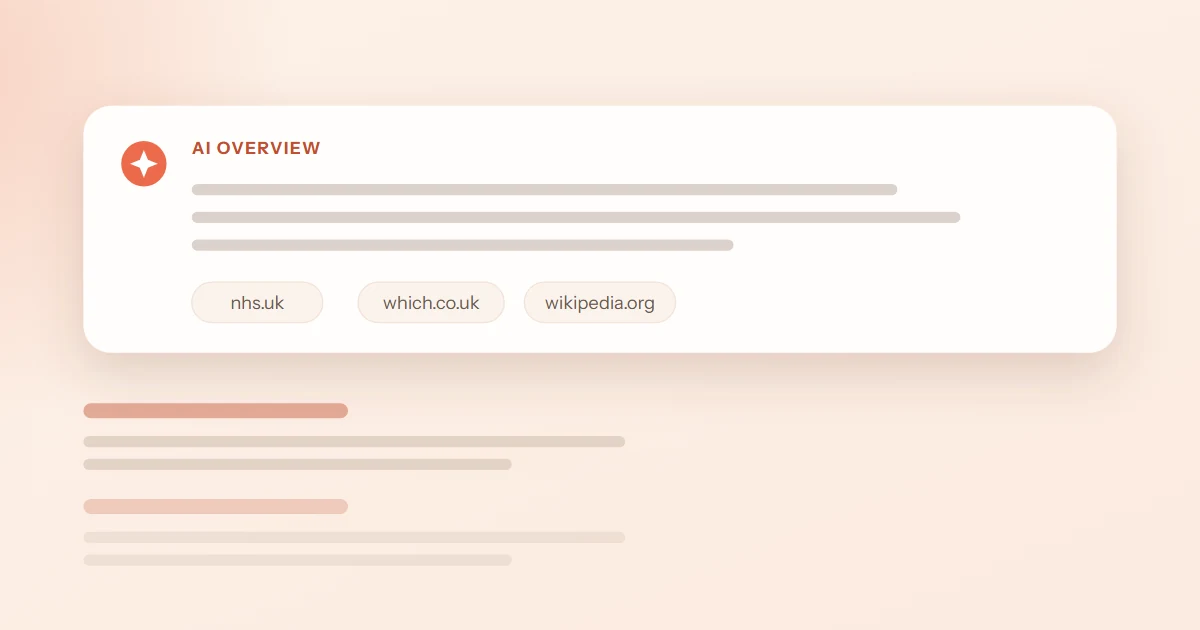
- Google’s answer layer is now three surfaces: AI Overviews (in search), AI Mode (a chat-first tab), and Gemini (the standalone assistant) — they share infrastructure but cite differently.
- All three lean on Google’s live index, so classic crawlability and authority still gate whether you’re even eligible to be cited.
- Pew found users click a traditional link on roughly 8% of visits when an AI summary appears, versus 15% without — the citation slot is where the attention goes now.2
- Query fan-out means one question becomes a dozen or more retrieval queries, so you can be quoted from a sub-question you never targeted — and absent despite ranking first. See a worked decomposition below.
- The winning move is the same across all three: be the most quotable, well-structured source for a specific buyer question — then measure your presence separately on each surface.
For two decades, “showing up on Google” meant one thing: a ranking position on a page of blue links. That single target has fractured. Ask Google a question today and you might get an AI Overview stitched from several sources, a full conversational thread in AI Mode, or — if you started in the Gemini app — a synthesized answer that may never show a link at all.
Treating these as one channel is the most common mistake teams make. They share Google’s retrieval backbone, but they surface, cite and convert differently. To win Google in 2026 you need a per-surface plan.
The three surfaces, and how each builds an answer
1. AI Overviews — the summary above the results
AI Overviews appear at the top of a normal search results page, summarizing an answer and linking to a handful of cited pages. They’re assembled from Google’s existing index, so a page has to be crawlable, indexed and reasonably authoritative before it can be quoted.3 The practical implication: your SEO foundation is the price of admission.
2. AI Mode — search as a conversation
AI Mode is a dedicated, chat-first experience that fans a single question into many background queries (“query fan-out”) and synthesizes the results into a longer, follow-up-friendly answer. Because it decomposes intent into sub-questions, breadth matters: pages that cleanly answer a specific sub-question can be pulled in even when they’d never rank #1 for the head term.
3. Gemini — the standalone assistant
In the Gemini app, the model blends what it learned in training with live retrieval when the question warrants it. Here parametric memory carries more weight — how your brand was described across the web that Google trained on shapes the default answer before any page is fetched.
The mental model: AI Overviews and AI Mode are retrieval-heavy (fast to influence via publishing); Gemini blends retrieval with memory (slower, shaped by broad corroboration). You need both the fast loop and the slow loop.
What all three reward
Despite their differences, the same content traits keep surfacing in what Google chooses to quote:
- A direct, self-contained answer near the top of the page — not buried below a story.
- Claims attached to numbers and named sources, which survive synthesis with attribution intact.
- Clean, semantic HTML and Product / FAQ structured data so facts are machine-legible.
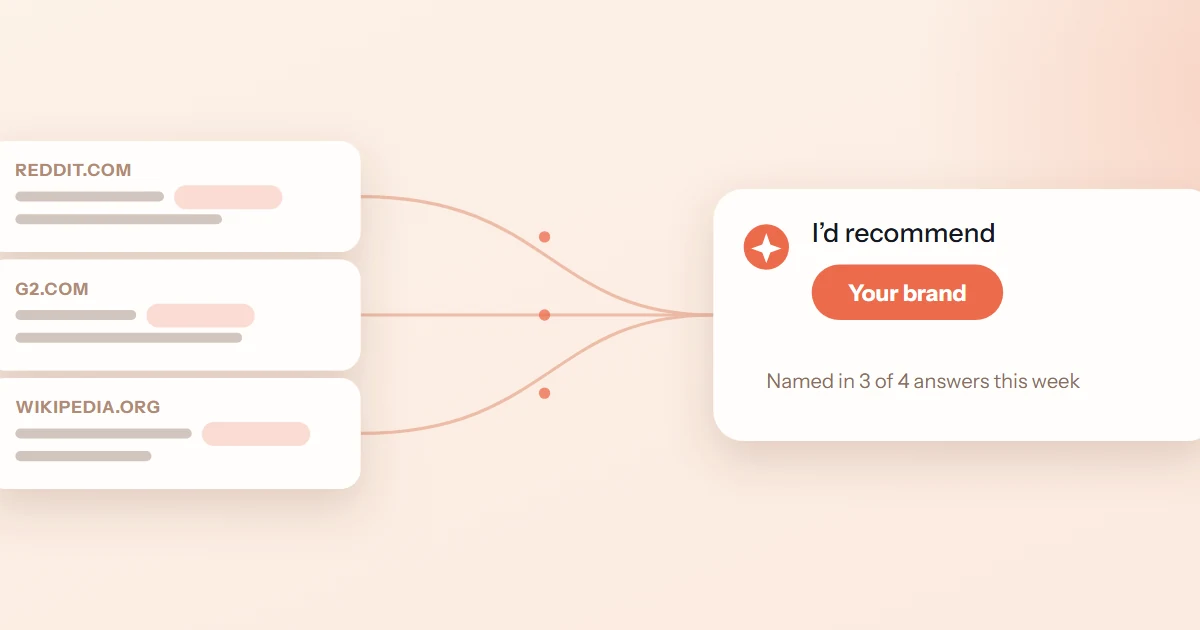
- Corroboration off your own domain — review sites, forums and reference pages that repeat the same facts.
Query fan-out: what it is, and what it does to your pages
Query fan-out is the step where a generative engine turns one user question into several retrieval queries, runs them all, and writes its answer from what comes back. Google uses the term for AI Mode, but the behaviour is general: any assistant that searches before it speaks decomposes first. It is the single most consequential difference between ranking and being cited, because it means one question is not one contest. It is a dozen or more, and you only have to win one of them to end up in the answer.
What that changes in practice: a page that ranks fourth for the head term can still be the page quoted, if it is the best answer to a sub-question the user never typed. And a page that ranks first can be absent from the answer entirely, because the sub-questions the engine actually issued — price, fit, drawbacks, what other buyers said — are not questions that page answers in its own words.
Here is one ordinary buyer question decomposed along the axes an engine would plausibly reach for. These sub-queries are modelled from the wording, not queries any engine was observed to issue — the distinction matters, and we come back to it below.
| Axis | Modelled sub-queries for “best CRM for a small sales team” |
|---|---|
| Who is on the shortlist | top crm 2026 · crm comparison · crm recommendations |
| Head to head | crm comparison table · compare crm options · crm vs alternatives |
| What it costs | crm pricing · how much does crm cost · crm hidden costs |
| Fit for this situation | crm for a small sales team · is crm good for a small sales team · crm requirements for a small sales team |
| Objections and risk | crm problems · crm pros and cons · is crm worth it |
| Evidence people trust | crm reviews · crm reddit · crm case study |
| Recency | crm 2026 · best crm for a small sales team 2026 |
Four of those seven axes — price, fit, objections and evidence — are things most product pages never state plainly on the page itself. That is the gap, and it is usually closed with H2s on pages you already have rather than with new pages. You can run your own questions through the free query fan-out generator, which shows which axis produced each sub-query so you can argue with the reasoning instead of trusting a list.
Modelled fan-out is a hypothesis; measured fan-out is evidence. Some engines publish the retrieval queries they issued, and Praised reports those per run — along with how many engines reported at all, because an engine that publishes nothing has not told you it searched for nothing. A generator can suggest where to look. Only a measured run tells you whether the page you wrote against it changed anything.
Measuring presence on each surface
Because the surfaces differ, a single “Google score” hides more than it reveals. Track them apart: does your brand appear in the AI Overview for a buying query, is it cited in an AI Mode thread, and does Gemini name you unprompted? Each is a separate rate, sampled repeatedly, with a confidence interval — one lucky answer proves nothing. Start with the surface you can read directly: a free AI Overview check shows whether Google generated an Overview for a given query and which domains it cited.
Google didn’t replace ten links with one answer. It replaced them with three different answers, each choosing sources its own way.
A practical 3-surface checklist
- Foundation: confirm your key pages are crawlable and indexed — without this you’re ineligible for Overviews and AI Mode.
- Answer-first: rewrite each priority page to lead with the exact answer to its buyer question.
- Decompose: add sections that answer likely sub-questions (pricing, comparison, integration) so AI Mode’s fan-out can find you.
- Corroborate: earn consistent third-party mentions so Gemini’s memory learns the right facts.
- Measure per surface: sample each independently and watch the rates move.
Frequently asked questions
Query fan-out is the step where an engine turns one user question into several retrieval queries, runs them, and writes its answer from what comes back — which is why a single question creates a retrieval surface of a dozen or more queries rather than one ranking contest. Our free query fan-out generator models that decomposition for any question, with worked examples.
Nobody publishes a stable number, and any tool quoting one is guessing. Google describes AI Mode as issuing multiple background queries per question; the count varies by engine, by question and by run. What you can act on is the shape of the decomposition — which kinds of sub-question get asked — not a count.
Not yet — it’s a separate, opt-in experience alongside traditional results and AI Overviews. But its conversational, fan-out design is where Google is investing, so building for it now is a hedge that also improves your Overviews presence.
No — the underlying traits (direct answers, sourced claims, structured data, corroboration) serve all three. What differs is emphasis: Overviews and AI Mode reward fresh, retrievable pages; Gemini rewards broad, consistent representation across the web it trained on.
Partly — Overviews show their cited sources, so you can check specific queries manually with our free AI Overview checker. For a reliable read you need to sample many buyer prompts repeatedly and record how often your domain appears, rather than eyeballing a single result.
Sources & further reading
- "GEO: Generative Engine Optimization", Aggarwal et al., KDD 2024 / arXiv:2311.09735.
- Gartner — "Search Engine Volume Will Drop 25% by 2026", February 2024.
- Pew Research Center — "Google users are less likely to click on links when an AI summary appears", July 2025.
- Google Search Central — "AI features and your website".
- Google — Gemini product updates and AI Mode announcements.

Head of Research at Praised. Maya leads the measurement methodology behind Praised's visibility metrics — prompt-suite design, sampling, and confidence intervals — and writes about how generative engines choose what to say.