- Niche B2B categories have thin source material — often only a handful of substantive documents exist for a given spec query, so one authoritative page can dominate the answer.
- Technical buyers ask AI tools spec-laden questions ("IP69K-rated for washdown in food plants") — being the page that answers the constraint wins the mention.
- Long sales cycles amplify shortlist value: one AI recommendation can start a six-figure, multi-month deal you'd otherwise never compete for.
- The playbook: spec-complete comparison content, application notes, plainly stated standards compliance, distributor/review corroboration — and measurement built for small-n prompt suites, where confidence intervals matter most.
Ask an AI tool for "the best running shoes" and it has hundreds of thousands of documents to synthesize — roundups, forum wars, decades of reviews. Your odds of changing that answer with content are slim.
Now ask it for "an LED high-bay rated IP69K for daily washdown in a food plant, at least 150 lm/W, with DALI-2 dimming." How many documents on the entire internet substantively address that combination of constraints? A handful. Maybe fewer. Whoever wrote the best one is probably in the answer — and often is the answer.
That's the core B2B asymmetry: generative engines have to answer from whatever exists, and in niche categories almost nothing exists. In consumer GEO you fight for a share of a crowded synthesis. In B2B you can frequently just… be the source material.
Why B2B is the fastest GEO payback
Three structural reasons, in increasing order of importance:
1. Thin corpora mean movable answers. The GEO research found content-side changes (statistics, citations, quotations) lifted visibility in generative answers by up to ~40% on average across a broad query set1 — and sparse categories sit at the favorable end of that distribution, because there's little competing material to displace. We routinely find niche-category mention rates moving in weeks, where consumer categories grind for quarters.
2. Technical buyers were early, quiet adopters. Engineers treat AI tools the way they treated Stack Overflow: a faster way to traverse documentation. Procurement uses them to draft requirement matrices and seed vendor lists. None of this shows up in your analytics — it's the zero-click journey in its purest form, happening before any vendor knows an evaluation exists. Meanwhile the broad behavioral shift keeps compounding: Gartner projected a 25% drop in traditional search volume by 2026 as journeys move into chatbots and agents.2
3. Deal economics multiply every mention. If an AI recommendation nudges one incremental buyer into a $40 purchase, that's a nice conversion. If it puts you on the shortlist for a $200k ACV deal with an 8-month cycle and a 3-vendor bake-off, a single answer carried pipeline weight that consumer marketers can only dream about. Small prompt volumes, huge per-prompt stakes.
How technical buyers actually phrase it
B2B AI tool queries don't look like keywords; they look like requirements. Real patterns we find in category prompt research:
- "LED high-bay for a food-processing plant, IP69K washdown rated, needs a DLC Premium listing"
- "Alternatives to [incumbent] for warehouse lighting controls, DALI-2 support required"
- "QMS software for a 15-person medical device startup that needs ISO 13485 and FDA 21 CFR Part 820 templates"
- "ETL tool that can handle CDC from a 2 TB Oracle instance into Snowflake, SOC 2 Type II required"
Notice what each contains: a category, a quantified constraint, and a compliance requirement. The AI tool's job is constraint satisfaction — it will name whichever vendors it can verify against the constraints. Verification requires the numbers and the certifications to be findable in text. That single observation generates most of the playbook.
It also means B2B GEO is less about persuasion than about evidence logistics. A consumer answer weighs sentiment ("users love it"); a spec-constrained answer weighs verifiable facts ("IP69K; DLC Premium listed"). Sentiment you influence slowly, through years of reviews. Facts you can ship this sprint — which is the second reason payback comes fast here. The buyer's own prompt hands you the acceptance criteria; your job is to make sure the passing evidence exists in crawlable text before the next evaluation runs.
The disqualification trap: AI tools drop vendors they can't verify. If your accuracy spec lives in a PDF datasheet the crawler can't parse, or your ISO cert is a badge image with no text, the model can't confirm you meet the constraint — so it recommends the competitor whose spec table is plain HTML. You're not losing on merit; you're losing on legibility.
The B2B GEO playbook
Five assets, in the order that usually maximizes payback:
| Asset | What it does in the answer | Build notes |
|---|---|---|
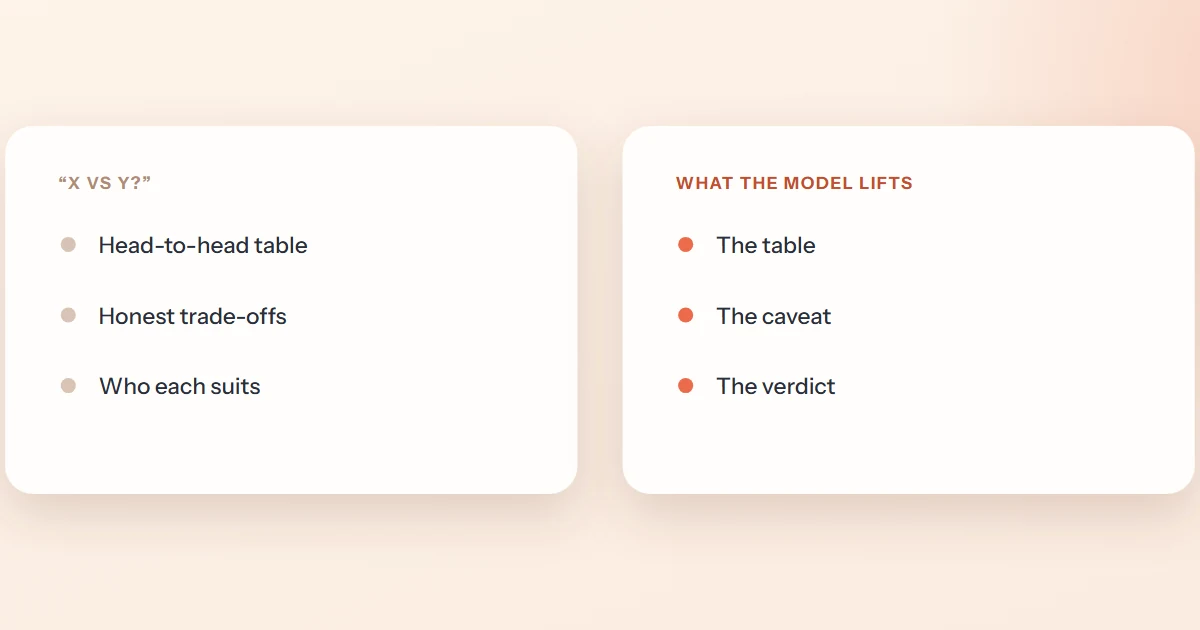
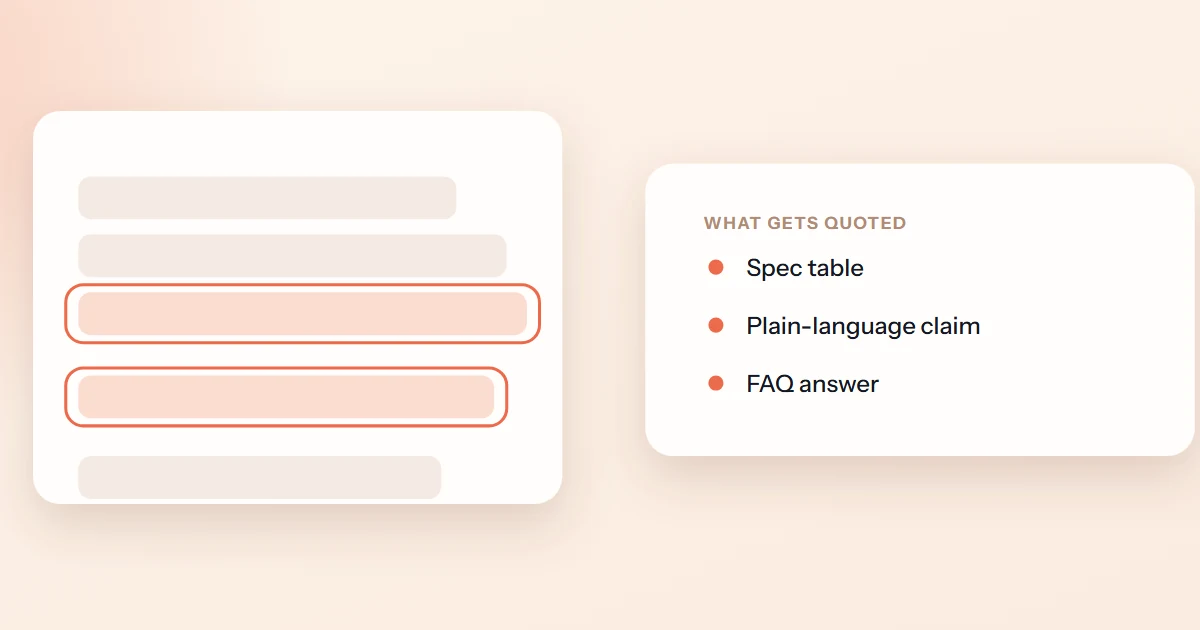
| Spec-complete comparison page | Becomes the retrieved source for "X vs Y" and "alternatives to Z" queries | Honest side-by-side including where you lose; full spec tables in HTML, not screenshots |
| Application notes | Wins constraint-laden queries ("for food plants", "for cold storage") | One page per use case: problem, relevant specs, install/integration detail, named standards |
| Standards & compliance page | Lets the model verify ISO/IEC/SOC 2 requirements and keep you in the shortlist | Plain sentences: "Certified ISO 9001:2015; every fixture ships with an LM-79 test report from an accredited lab." Add Product/Organization schema3 |
| Distributor & review corroboration | Independent echo that turns your claims into consensus facts | Sync spec sheets with distributors so their listings repeat your numbers; keep G2/Capterra/TrustRadius current for SaaS |
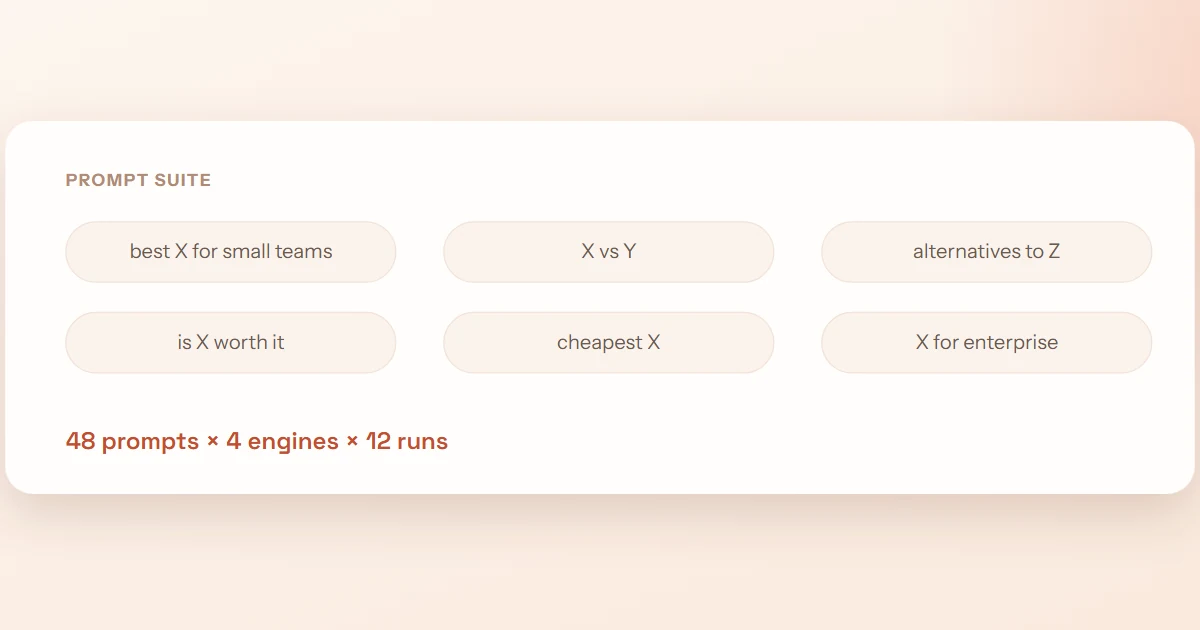
| Niche prompt suite | Tells you whether any of it is working | 20–40 real buyer prompts, run repeatedly per engine, scored with confidence intervals |
Two details deserve emphasis. First, state compliance plainly, in prose. Certifications are binary retrieval targets — a buyer's prompt says "ISO 13485 required," and the model searches for exactly that string near your name. Second, distributor listings are underrated corroboration: a distributor catalog page repeating your 150 lm/W figure is an independent domain confirming your spec, which is precisely the consensus signal models weight.
Praised runs your niche buying prompts across ChatGPT, Claude, Gemini and Perplexity and shows mention rate, share of voice and the exact answers — so you build the five assets against measured gaps, not guesses.
Get a free visibility reportTwo worked mini-examples
Worked example, industrial: a lighting manufacturer
Take a mid-size maker of LED high-bays for food-processing plants. The prompt that matters: "LED high-bay IP69K for washdown, DLC Premium listed." The usual diagnosis: the efficacy figure lives in PDF datasheets, the washdown story lives in a sales deck, and nothing on the web ties the product to IP69K washdown in text.
The fix is four pages: an application note ("Lighting for washdown areas in food plants") stating the IP69K rating and the 150 lm/W figure in the first hundred words; an HTML spec table with Product schema; a compliance page listing certifications as sentences; and a distributor sync so two catalog listings echo the same numbers. In a category where perhaps a dozen substantive documents exist, that makes four of them yours, plus two independent echoes: the position from which a brand gets named on washdown-constrained prompts.
SaaS: compliance software for medical-device startups
An eQMS vendor targets pre-revenue medical-device companies. The prompt: "QMS software for a small medical device startup, ISO 13485 and 21 CFR Part 820." Their gap wasn't specs — it was comparison content. AI tools answered with two enterprise incumbents because the only "vs" pages on the web were written by those incumbents, framing the category around enterprise needs.
They shipped an honest comparison ("[Vendor] vs enterprise QMS platforms for startups") conceding enterprise depth while quantifying their edge — time-to-validation, startup pricing, pre-built 13485 templates — and mobilized thirty G2 reviews from startup-segment customers, which put "best for small teams" language on an independent domain. The comparison page became the most-cited source for startup-qualified prompts; share of voice on the startup segment roughly tripled while the incumbents kept the enterprise prompts. That's the B2B pattern in miniature: don't fight for the category answer, own the qualified answer.
Both examples share a shape worth naming. Neither brand created new claims — the specs and the startup fit already existed. What they created was legibility: the claims moved from PDFs, decks and tribal knowledge into crawlable, corroborated text aligned with how buyers phrase constraints. In thin corpora, that translation work alone is frequently the whole game.
Measuring niche suites: small n, honest intervals
B2B prompt universes are small — there may only be 25 questions your buyers realistically ask. That smallness cuts both ways. It means full coverage is cheap: you can measure your entire demand surface, something a consumer brand facing thousands of query variants can only sample. But it also means every statistical shortcut that consumer-scale data forgives will burn you. With 25 prompts, one flaky answer swings a naive mention rate by four points. Small n is fine; pretending it's precise isn't.
- Build the suite from real buyer language: sales-call transcripts, support tickets, RFP requirement lines — not keyword tools.
- Run each prompt multiple times per engine. Answers are stochastic; 25 prompts × 5 runs × 4 engines is 500 samples, which is a measurement. 25 single runs is an anecdote.
- Report intervals, not points. A mention rate of 8/20 isn't "40%" — it's roughly 22–61% at 95% confidence. Whether that's compatible with last month's 30% is exactly what the interval tells you.
- Judge movement against overlap. With small suites, only large true shifts separate cleanly from noise — which is honest, because in B2B the shifts you're engineering (absent → consistently present) are large.
- Weight prompts by pipeline value. Being named on the three prompts your biggest deals ask is worth more than blanket coverage; track them as a named segment.
This is deliberately the same statistical discipline you'd demand from an A/B test — just applied to answers instead of clicks. Automate the sampling (this is what a platform like Praised exists for) but never let automation hide the interval. If you're the one who has to defend these numbers internally, Praised for in-house teams walks through exactly that job — the CEO-safe number, the fix queue, and proving last quarter's work moved something.
Frequently asked questions
The opposite — a generic answer means the corpus is empty and the seat at the table is unclaimed. When no vendor has written the authoritative application note for your niche, the first credible one tends to get adopted wholesale by retrieval engines. Vague answers are the strongest buy signal in GEO.
Not the parts that win answers. A gated PDF is invisible to crawlers and therefore absent from the shortlist conversation; you're trading model visibility for form-fills from buyers who mostly already found you. Keep specs, comparisons and compliance open; gate genuinely bespoke assets (ROI calculators, validation packages) that pre-sold buyers will happily exchange contact details for.
Retrieval-driven engines (Perplexity, ChatGPT search, AI Overviews) can cite new pages within days to weeks of indexing, so constraint-query wins often land inside a quarter. Parametric shifts — the model "just knowing" you — track model release cycles and corroboration accumulation, so budget several months. Sequence accordingly: application notes and comparisons first for fast retrieval wins, corroboration in parallel for the slow loop.
Sources & further reading
- Aggarwal, P., et al. — "GEO: Generative Engine Optimization", KDD 2024 / arXiv:2311.09735 — tested nine tactics across ~10k queries; citations, quotations and statistics lifted visibility up to ~40%.
- Gartner — "Gartner Predicts Search Engine Volume Will Drop 25% by 2026, Due to AI Chatbots and Other Virtual Agents", February 2024.
- Schema.org — Schema.org structured data vocabulary (Product, Organization, FAQPage types).
- Pew Research Center — "Google users are less likely to click on links when an AI summary appears in the results", July 2025.