- Comparison and alternatives queries are high-intent and map directly onto content you can build and control.
- AI tools lift structured, even-handed comparisons because they’re pre-shaped like an answer.
- Fairness wins: a credible comparison that names where the other option is better is more quotable than a one-sided pitch.
- One comparison page can capture a whole cluster of “X vs Y,” “Y vs X,” and “alternatives to X” prompts.
When a buyer is close to deciding, they stop asking “what should I look for” and start asking “X or Y?” That question has a clean, factual answer — and if you’ve published a fair, structured comparison, the AI tool can assemble its response almost entirely from your page.
Why comparison pages punch above their weight
Two reasons. First, the query intent is unambiguous and late-funnel — a person comparing two products is near a decision. Second, a comparison is already answer-shaped: a table of dimensions, a verdict per use case. The model does less synthesis work, and low synthesis effort correlates with getting quoted.
Counterintuitive but repeatedly true: the most quotable comparison is the honest one. A page that admits “choose the other tool if you need X” reads as credible and gets cited even by buyers you’ll lose on X — while winning the buyers you fit.
Anatomy of a comparison page AI will quote
Lead with a verdict
Open with a two-sentence bottom line: who each option is for. That’s the sentence an AI tool will lift. Everything below substantiates it.
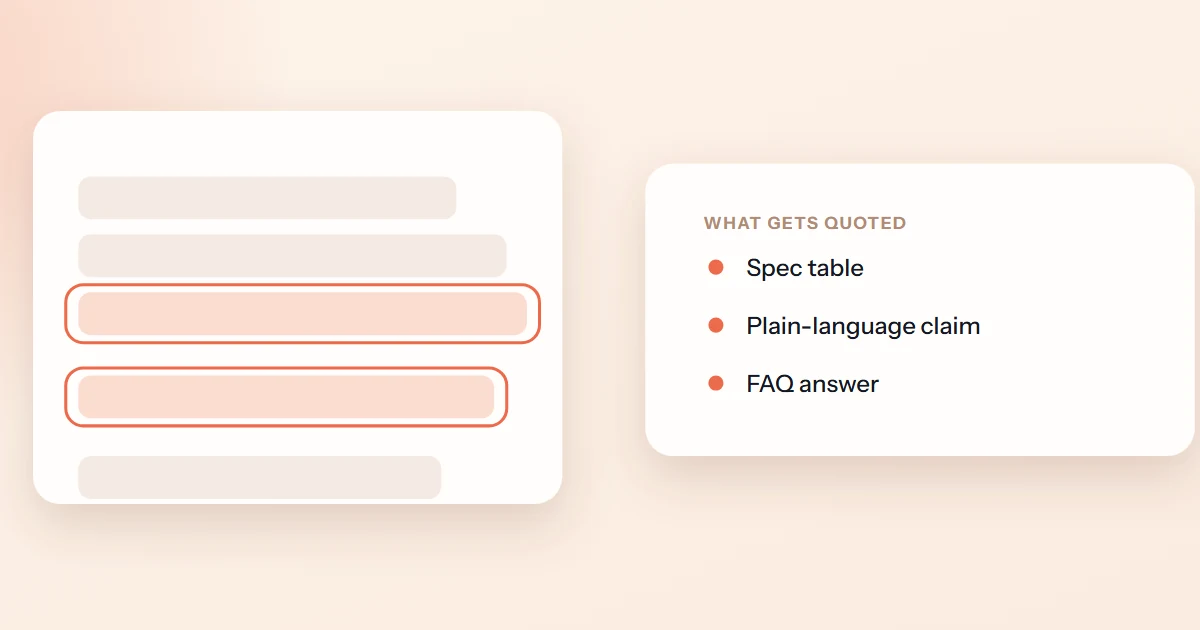
A clean, factual comparison table
Dimensions down the side, options across the top, specific values in the cells. Numbers and concrete capabilities — not “excellent” vs “good.” Structured tables extract cleanly.
Use-case guidance
Follow with “choose X if… / choose Y if…” prose. This is what turns a spec dump into a recommendation the model can repeat with context.
| Dimension | Your product | Competitor |
|---|---|---|
| Best for | Obligation tracking with clause-level citations | End-to-end contract lifecycle |
| Setup | Self-serve, hours | Guided onboarding, weeks |
| Human review | Required before tracking | Optional |
| Native e-signature | No — integrates | Yes |
Notice the table names a dimension where the competitor wins (e-signature). That honesty is what makes the whole page trustworthy to a model synthesizing a balanced answer.1
One page, a cluster of queries
A single well-built “X vs Y” page can satisfy “X vs Y,” “Y vs X,” “is X better than Y,” and “alternatives to Y” — because the AI tool is matching intent, not exact strings. Build the page once, cover the constellation.
A one-sided comparison sells to nobody the model trusts. A fair one gets quoted to everybody who asks.
Build checklist
- Lead with a two-sentence verdict naming who each option is for.
- Add a factual comparison table with specific values, including where competitors win.
- Write “choose X if / choose Y if” use-case guidance.
- Keep facts about competitors accurate and current — errors destroy credibility and invite corrections.
- Mark it up and measure whether AI tools cite it for the target “vs” prompts.
Frequently asked questions
Done fairly, it’s the opposite of risky — it captures high-intent comparison queries and builds the credibility that makes AI tools trust your page. The risk is inaccuracy: never misstate a competitor’s facts, because corrections travel and damage trust.
Put them on a review cadence — competitor pricing and features change, and an AI tool that catches a contradiction may drop or caveat your page. Quarterly checks on the factual cells are usually enough.
Favor focused ‘X vs Y’ pages over a giant matrix — each maps cleanly onto a specific buyer prompt, which is what AI tools match against. A hub page can link them together for humans.
Sources & further reading
- "GEO: Generative Engine Optimization", Aggarwal et al., KDD 2024 / arXiv:2311.09735.
- Pew Research Center — "Google users are less likely to click on links when an AI summary appears", July 2025.
- Schema.org vocabulary — Product, Offer, FAQPage, Organization types.