- AI answers reveal your real competitive set — the brands a model actually name-checks, which may differ from your assumed competitors.
- Share of voice across a prompt suite is the cleanest scoreboard — your mentions vs. all brand mentions.
- The valuable insight is where competitors win: which engines, which buyer intents, which cited sources.
- Gaps in the sources models cite are often the fastest lever — earn a presence where only competitors appear.
Ask an AI tool your category’s core buying question ten times and you’ll find a pattern: a small set of brands recurs, sometimes in a stable order, sometimes shuffling. That recurring set is your competitive field as the model reads it — and it’s often not the list your marketing team keeps on a slide.
Find your real competitive set
The brands you benchmark against in decks may not be the ones AI tools name. Run your buyer prompts repeatedly and record every brand mentioned. The frequently-named set is who you’re actually competing with in the answer — sometimes a scrappy newcomer the model loves, sometimes an incumbent you’d discounted.
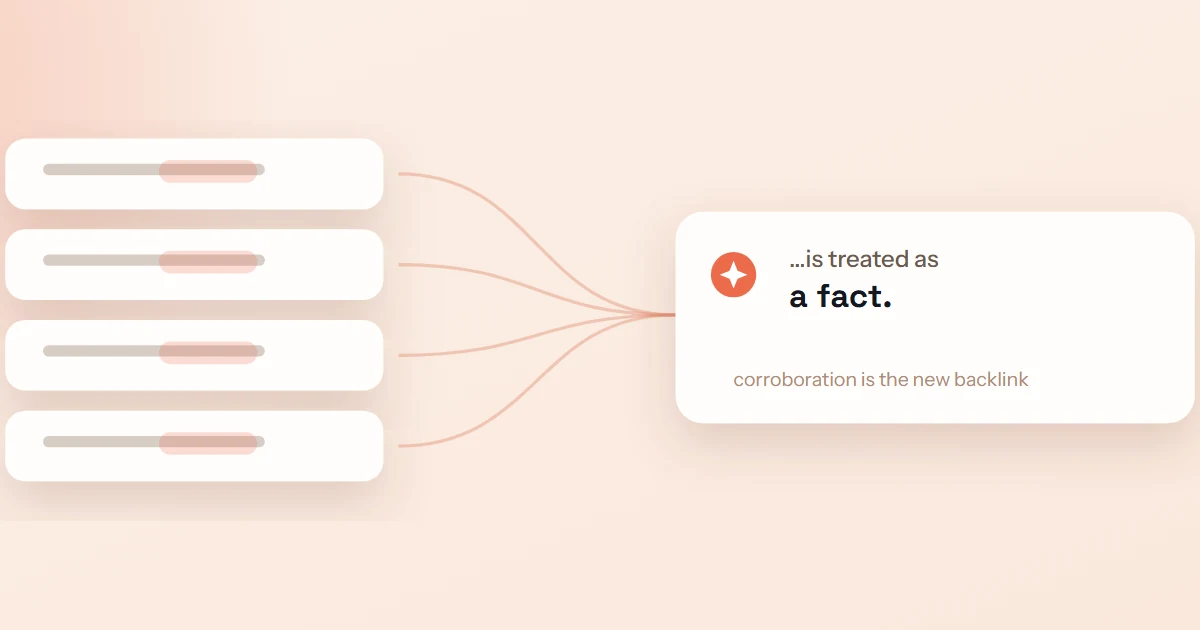
A recurring surprise: the model’s shortlist is shaped as much by third-party corroboration as by product quality. A competitor that’s ordinary but heavily reviewed on the sites the model trusts can outrank a better product that’s only described on its own domain.
Read the field on three axes
By engine
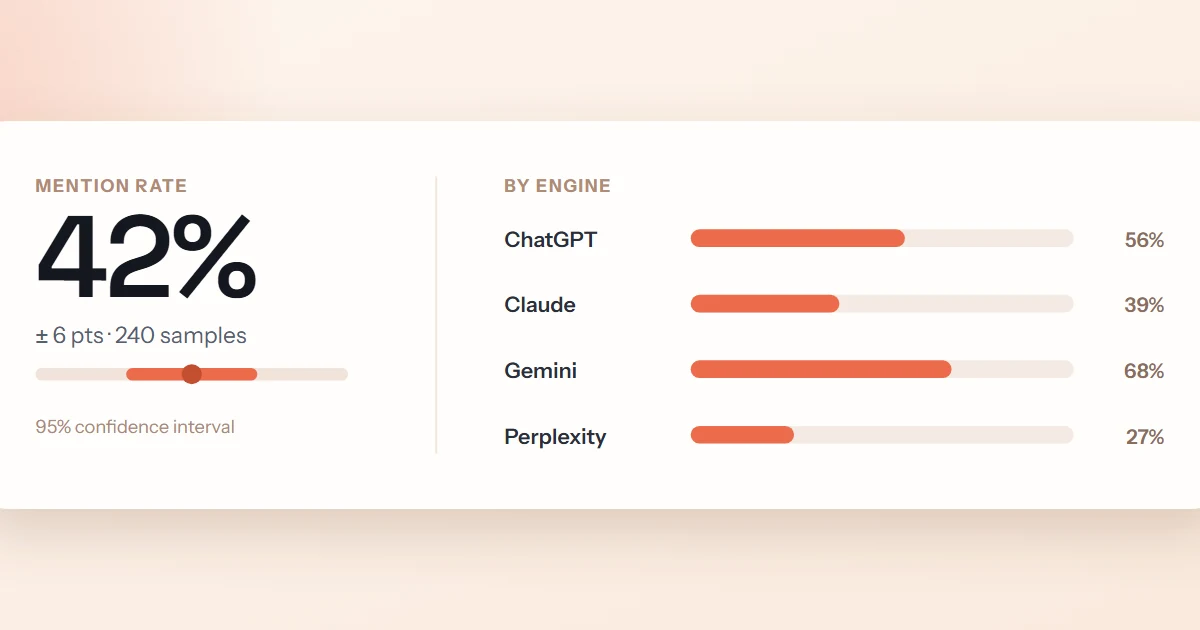
A competitor may dominate Gemini (strong in Google’s index) while you lead on Perplexity (strong, fresh, citable content). Per-engine share of voice tells you where to focus, and where you’re quietly losing.
By buyer intent
Split prompts into discovery, comparison, pricing and recommendation. You might own discovery (“what tools do X”) but lose recommendation (“which should I buy”) — a signal that your positioning content is weaker than your awareness content.
By cited source
When engines browse, note which domains they cite. If g2 and a specific subreddit keep appearing and you’re absent there, that’s a precise, actionable gap — more useful than knowing your aggregate number is low.
| Axis | Question it answers | Action it points to |
|---|---|---|
| Engine | Where am I losing? | Focus content or crawlability on that engine |
| Intent | Which funnel stage? | Fix positioning vs. awareness content |
| Source | Who’s cited, not me? | Earn presence on those domains |
Turn the read into moves
Competitive analysis is only useful if it ends in a page or a campaign. The tightest loop: find a prompt where a competitor wins, read the answer to find out why (a comparison, a stat, a cited review), then publish the asset that gives the model a reason to include you — and re-measure.
You can’t read a competitor’s SEO strategy. You can read, verbatim, which of them the model recommends and why.
A competitive-analysis routine
- Run your buyer prompt suite repeatedly; record every brand and every cited source.
- Compute share of voice overall and by engine and intent.
- Identify the two prompts where competitors most reliably beat you.
- Read those answers to find the reason — a comparison, a stat, a review.
- Publish the counter-asset, then re-measure against your baseline with confidence intervals.
Frequently asked questions
Run your category’s buying prompts many times and tally which brands recur — that frequently-named set is your competitive field as the model reads it. It often differs from the competitor list marketing assumes. For Google specifically, the quickest version is to run a buying query through an AI Overview check and read off the domains it cites — those are the competitors already inside the answer.
For competitive analysis, yes — share of voice is relative, so it captures competitors’ movement and category growth in one number. Mention rate is still useful as your absolute presence, but it can rise while your share falls.
The retrieval loop can respond within days to weeks once new content is indexed; shifting a model’s trained defaults takes longer. Most teams measure movement on targeted prompts within a quarter.
Sources & further reading
- "GEO: Generative Engine Optimization", Aggarwal et al., KDD 2024 / arXiv:2311.09735.
- Pew Research Center — "Google users are less likely to click on links when an AI summary appears", July 2025.
- Gartner — "Search Engine Volume Will Drop 25% by 2026", February 2024.
- Schema.org vocabulary — Product, Offer, FAQPage, Organization types.